


TL;DR:
- Focusing on one or two digital marketing channels for 30 to 90 days yields better results than spreading resources thinly across many options. Small businesses should prioritize SEO and Google Ads to build long-term visibility and generate immediate traffic, respectively. Measuring revenue-focused metrics and integrating paid advertising, social media, and email marketing create a sustainable growth system.
Growing your business online is defined by your ability to master a focused set of digital marketing channels, convert website visitors into paying customers, and measure what actually drives revenue. The businesses that win online in 2026 are not the ones doing everything. They are the ones doing the right things consistently. That means SEO, Google Ads, a website built to convert, and a local presence that captures high-intent buyers. Answer Engine Optimisation (AEO) and AI-driven search are reshaping how customers find businesses, making it more urgent than ever to build authority through content that answers real questions. This guide gives you a practical, channel-by-channel approach to grow your business online without wasting budget on tactics that do not move the needle.
What digital marketing channels should a small business focus on first?
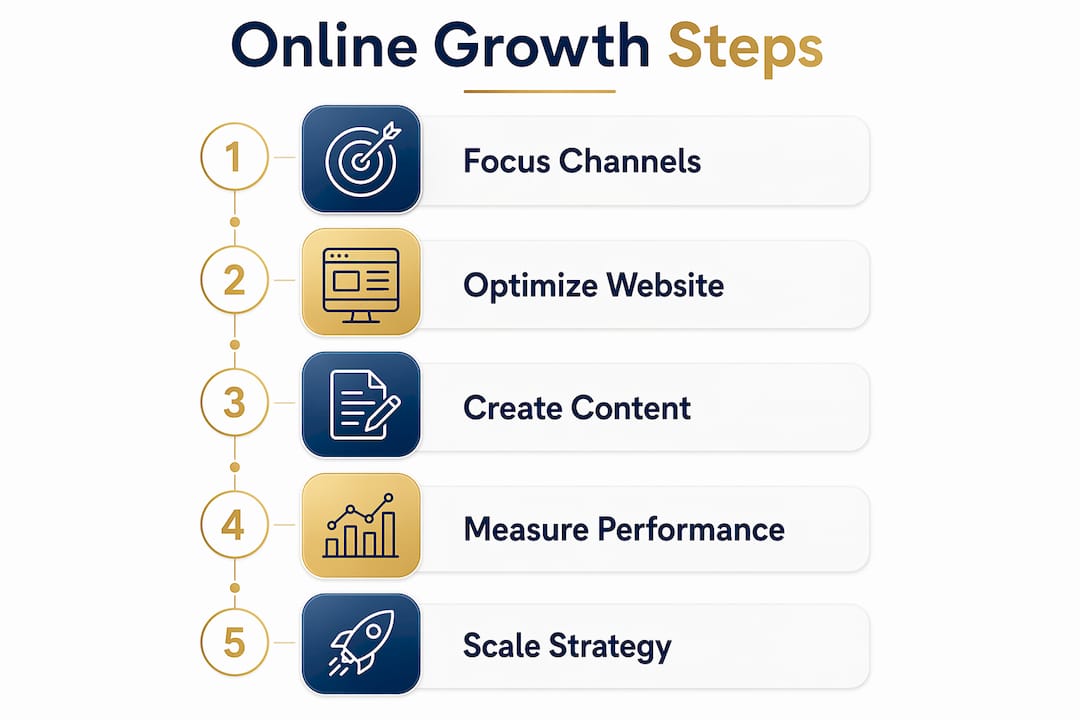
The single biggest mistake small business owners make is spreading their budget across too many channels at once. Businesses that manage too many channels simultaneously dilute their resources and make it impossible to know what is actually working. Pick one or two channels, commit fully, and measure results before adding more.
The two most effective starting points for most service-based businesses are organic SEO and Google Ads. SEO builds long-term visibility and compounds over time, but SEO typically takes 3–6 months to show meaningful traffic. Google Ads delivers results faster, putting your business in front of buyers who are actively searching right now. The trade-off is cost. Ads stop the moment you stop paying. SEO keeps working.
| Channel | Cost | Timeline | Best for |
|---|---|---|---|
| Organic SEO | Low ongoing | 3–6 months | Long-term authority and traffic |
| Google Ads | Pay per click | Immediate | High-intent buyers, fast results |
| Meta Ads | Pay per click | 1–4 weeks | Brand awareness, retargeting |
| Local SEO | Low | 4–8 weeks | Service businesses with a local area |
| Email marketing | Very low | Ongoing | Retention and repeat sales |
The recommended testing period for any single channel is 30–90 days. That window gives you enough data to judge performance fairly. Cutting a channel after two weeks is not a test. It is guesswork.
Pro Tip: If you are a local service business, start with Google Business Profile optimisation and local SEO before spending on ads. Local search traffic is free, high-intent, and often overlooked by competitors.
How to optimise your website and local presence for online growth
Your website is your most important sales asset. A high-converting website must have a clear headline stating who you help, a visible call to action above the fold, fast load speed, and a contact method that works within 30 seconds of landing. If a visitor cannot work out what you do and how to contact you in under 10 seconds, they leave.

Most small business websites fail on the basics. They load slowly on mobile, bury the phone number in the footer, and use vague headlines like “Welcome to our business.” Replace that with a specific statement: “We help Perth salon owners fill their books with paying clients.” That one change alone lifts enquiry rates.
Local SEO is equally critical. Claiming and optimising your Google Business Profile is the fastest free action a local service business can take to appear in map pack results. Map pack placements sit above organic results and capture buyers who are ready to act now.
Key steps to optimise your local presence:
- Claim your Google Business Profile and verify your address
- Add your correct business category, hours, and service area
- Upload at least 10 photos of your premises, team, and work
- Collect Google reviews consistently and respond to every one
- Add your business to relevant local directories with consistent name, address, and phone details
- Post weekly updates to your profile to signal activity to Google
Pro Tip: Ask every satisfied client for a Google review within 24 hours of their appointment or project completion. Recency and volume of reviews directly influence your map pack ranking.
What role does content and AI-driven SEO play in sustainable business growth?
Content is the engine behind long-term online growth. The businesses that dominate search results in 2026 are not the ones publishing the most content. They are the ones publishing content that directly answers the questions their customers are typing into Google and asking AI tools like ChatGPT and Perplexity.
This is the core of Answer Engine Optimisation (AEO). AEO focuses on creating content that answers specific user queries, making it the primary method for maintaining visibility in both traditional search and AI-driven results. When a potential client asks an AI assistant “what is the best digital marketing agency in Perth,” the AI pulls its answer from content that has already established authority on that topic. If your content does not exist, your business does not get mentioned.
Building that authority requires E-E-A-T: Experience, Expertise, Authoritativeness, and Trustworthiness. E-E-A-T principles are the foundation Google uses to evaluate whether your content deserves to rank. Publishing case studies, sharing real client results, and writing from genuine industry experience all signal E-E-A-T to search engines and AI models alike.
Chasing viral trends produces short-term spikes and long-term nothing. Building content rooted in E-E-A-T produces consistent authority that compounds month after month. The businesses that understand this are the ones that show up in AI citations and featured snippets years from now.
Content types that build SEO authority and customer trust:
- FAQ pages that answer the exact questions your clients ask before buying
- Case studies showing before-and-after results for real clients
- How-to guides that solve a specific problem your audience faces
- Service pages optimised for local keywords and buyer intent
- Video content published to YouTube and embedded on your website
- Blog posts that address industry questions and link to your service pages
Getting your brand mentioned in large language models like ChatGPT requires the same discipline as traditional SEO. Publish authoritative content, earn backlinks from credible sources, and maintain a consistent brand voice across every platform. AI models cite sources they trust. Build the kind of digital presence that earns trust over time.
How to measure performance and scale your online marketing effectively
Measuring the wrong things is as damaging as measuring nothing. Traffic numbers feel good but they do not pay wages. The metrics that matter are cost per lead, conversion rate, customer lifetime value, and return on ad spend (ROAS). Revenue-driven metrics give you a true picture of whether your marketing is generating profit or just activity.
Setting up measurement correctly from day one is non-negotiable. Google Analytics and conversion tracking are the minimum prerequisites for understanding where your traffic comes from and which sources actually convert. Without this data, you are making budget decisions based on assumptions.
A practical approach to scaling your marketing:
- Set up Google Analytics 4 and configure conversion events for phone calls, form submissions, and purchases.
- Run your chosen channel for a full 30–90 day testing period before drawing conclusions.
- Calculate your cost per lead for each channel at the end of the testing period.
- Double the budget on the channel with the lowest cost per lead and highest conversion rate.
- Add a second channel only after your primary channel is consistently profitable.
- Review performance monthly and adjust targeting, creative, or budget based on data.
Pro Tip: Never judge a Google Ads campaign in the first two weeks. The algorithm needs time to learn your audience. Pulling campaigns early is the most common reason business owners conclude that ads “do not work.”
How to integrate paid advertising, social media, and email marketing to accelerate growth
Digital marketing works best as an integrated system, not a collection of separate tactics. Visibility, conversion, and retention must work together. Paid ads drive traffic. Your website converts it. Email marketing and social media keep those customers coming back.
Google Ads and Meta Ads serve different purposes. Google Ads captures buyers who are already searching for what you sell. Meta Ads build awareness among people who fit your customer profile but have not yet searched. Used together, they cover the full buying cycle. Understanding how to use social media for business means choosing platforms where your actual customers spend time, not every platform that exists.
Email marketing is the most underused channel for small businesses. You own your email list. No algorithm can take it away. A monthly newsletter, a post-purchase follow-up sequence, and a re-engagement campaign for lapsed clients are three simple systems that generate repeat revenue with minimal ongoing cost.
Integration tips that prevent wasted spend:
- Run Google Ads to a dedicated landing page, not your homepage
- Retarget website visitors with Meta Ads to recapture lost leads
- Collect email addresses at every customer touchpoint and automate follow-up
- Post consistently on one or two social platforms rather than inconsistently on five
- Use audience engagement strategies to build content that earns shares and backlinks
- Align your social media content with your SEO keywords to reinforce authority
The sequencing matters. Build your website and tracking first. Then activate one paid channel. Then layer in email and social. Adding channels before your foundation is solid wastes money and creates confusion about what is working.
Key takeaways
Growing your business online requires a focused channel strategy, a website built to convert, and consistent measurement of revenue-driven metrics rather than vanity numbers.
| Point | Details |
|---|---|
| Focus before expanding | Master one or two channels for 30–90 days before adding more to your mix. |
| Website converts traffic | A clear headline, fast load speed, and visible contact method are non-negotiable for results. |
| AEO builds AI visibility | Answer Engine Optimisation gets your brand cited in AI tools like ChatGPT and Perplexity. |
| Track revenue metrics | Measure cost per lead, ROAS, and conversion rate. Traffic alone tells you nothing useful. |
| Integration drives retention | Combine paid ads, email, and social media as a system, not separate tactics. |
What I have learned about growing businesses online after years in the trenches
Most business owners come to us having tried three or four channels at once and concluded that “digital marketing does not work.” What actually did not work was the approach. Spreading a modest budget across Google Ads, Facebook, Instagram, and SEO simultaneously means none of those channels gets enough investment to perform. The algorithm does not have enough data. The creative does not get tested properly. And the business owner burns out trying to manage all of it.
The businesses I have seen grow fastest online share one trait. They pick a channel, commit to it with real budget and real patience, and treat their website as a sales system rather than a digital brochure. A website that loads in under three seconds, answers the visitor’s question immediately, and makes it effortless to book or call will outperform a beautiful but slow website every single time.
The shift toward AI search is real and it is accelerating. Businesses that publish authoritative, question-answering content now are building the kind of brand presence that AI models will cite for years. That is not a prediction. It is already happening. The businesses ignoring it are quietly losing ground to the ones who understood it early.
Scaling also requires honest conversations about working capital. Flexible financing options help businesses fund marketing campaigns beyond what organic growth alone can support. Growth costs money before it makes money. The businesses that plan for that reality scale faster than those who do not.
— Business Warriors | Digital Marketing Agency
How Jarrodharman can help you grow your business online
Jarrodharman works with service-based businesses across Australia to build digital marketing systems that generate consistent leads and measurable revenue growth. The focus is on SEO, Google Ads, Meta advertising, and content strategy built around the Marketing Vortex Method, an integrated approach that connects every channel into one system.
Whether you need an SEO strategy for Perth or a full omnichannel marketing plan, Jarrodharman offers a clear, transparent process with guaranteed outcomes for qualifying clients. If you are ready to stop guessing and start building a marketing system that actually works, the next step is a conversation about your business goals and which channels will deliver the fastest return.
FAQ
What is the fastest way to grow my business online?
Google Ads delivers the fastest results for most service businesses because it targets buyers who are actively searching. Pair it with a high-converting landing page and conversion tracking from day one.
How long does SEO take to show results?
SEO typically takes 3–6 months to produce meaningful traffic. Consistent publishing, technical site health, and quality backlinks all accelerate the timeline.
What is Answer Engine Optimisation (AEO)?
AEO is the practice of creating content that directly answers specific user questions, making it more likely to appear in AI-generated search results from tools like ChatGPT, Perplexity, and Google’s AI Overviews.
How do I know which digital marketing channel is right for my business?
Start by identifying where your customers search for businesses like yours. Local service businesses benefit most from Google Business Profile and local SEO. Product-based businesses often see strong returns from Google Shopping and Meta Ads.
How many social media platforms should a small business use?
Focus on one or two platforms where your customers are most active. Posting consistently on two platforms outperforms posting sporadically across five. Quality and consistency matter more than platform count.