2 June 2026
Instagram marketing for beginners: 2026 guide
Unlock the power of Instagram marketing for beginners with our 2026 guide. Learn essential tools, strategies, and tips to boost your brand today!
TL;DR:
- Instagram marketing for beginners involves using business tools, content formats, and paid advertising to grow brands and generate measurable sales.
- Switching to a business account unlocks essential features like Insights, shopping tools, and contact buttons, making growth tracking possible.
Instagram marketing for beginners is the process of using Instagram’s business tools, content formats, and paid advertising features to grow your brand, attract customers, and drive measurable sales. This beginner’s guide to Instagram covers everything from account setup and content strategy to Instagram Insights, Meta Ads, and Shopping features. Whether you run a salon, a service business, or an ecommerce store, the tactics here are drawn from real 2026 benchmarks and apply directly to how you market on Instagram today. You will also see how Instagram fits into a broader SEO and paid advertising strategy, because no single channel works in isolation.
How to set up and optimise your Instagram business account
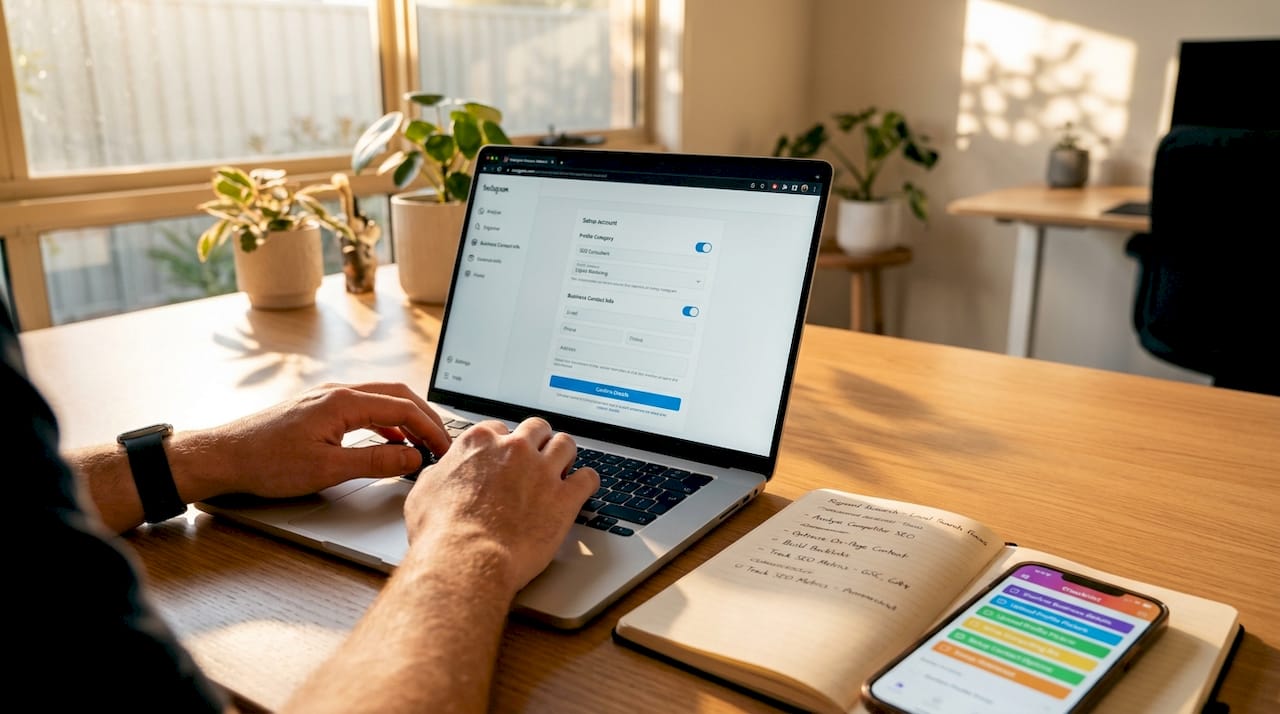
Switching to an Instagram Business account is the single most important first step in Instagram marketing for beginners. A business account unlocks Instagram Insights, shopping tools, ad access via Meta Ads Manager, and public contact buttons in about five minutes. Staying on a personal account is the most common beginner mistake, and it costs you every tool that makes growth measurable.
Steps to switch your account
- Open Instagram, go to Settings, then Account.
- Tap Switch to Professional Account and select Business.
- Choose the category that best describes your business (e.g., Beauty, Health, Retail).
- Connect your Facebook Page if you have one. This is required for running Meta Ads.
- Add your contact details: phone number, email, and physical address if relevant.
Once you are on a Business account, optimise your profile before posting a single piece of content:
- Use your logo or a professional headshot as your profile photo.
- Write a bio that states what you do, who you serve, and includes a call to action.
- Add a link in bio. Tools like Linktree or a dedicated landing page work well here.
- Select the correct business category so Instagram surfaces your account to relevant audiences.
Pro Tip: Write your bio as if someone has three seconds to decide whether to follow you. Lead with the outcome you deliver, not your job title.
Avoiding common digital marketing mistakes at this stage saves weeks of wasted effort later. A properly configured business profile signals credibility to both Instagram’s algorithm and your potential customers.
What content formats should beginners use on Instagram?
Instagram offers four primary content formats: feed posts, Carousels, Stories, and Reels. Each serves a different marketing function, and the data on their performance is clear. Videos reach 49% more of your audience than carousels or static photos, making video the highest-priority format for organic reach. That single fact should shape how you allocate your content creation time.
Here is how each format maps to a specific marketing goal:
- Reels (60 to 90 seconds): Best for discovery and reaching new audiences. Reels in this range receive 24% more shares than shorter clips, meaning your content travels further without paid spend.
- Stories: Best for building connection and retention with existing followers. Stories and Reels serve fundamentally different purposes. Stories keep your current audience warm; Reels bring in new people.
- Carousels: Best for engagement and saves. Educational carousels, step-by-step guides, and before-and-after posts perform strongly in service-based industries like beauty and wellness.
- Feed posts: Best for brand consistency and first impressions. Your feed is your shop window.
Posting frequency matters as much as format. Instagram Stories reach peaks at around slide 13, with reach declining sharply beyond that point. Six to thirteen Stories per day is the sweet spot for visibility without audience fatigue.
Caption strategy is equally important. Captions over 300 characters with storytelling elements boost comments by 70%. The formula is simple: open with a hook, tell a short story or share a specific insight, then close with a conversational question to invite replies.
Pro Tip: Do not try to master every format at once. Pick one format, post consistently for four weeks, then review your Insights before adding another.
Visual content is the foundation of Instagram’s algorithm. Beginners who treat every post as a deliberate choice, rather than random content, build audiences faster and with less wasted effort.
How to use Instagram Insights and analytics to grow your account
Instagram Insights is the native analytics tool available exclusively on Business and Creator accounts. Instagram Insights tracks metrics across all content types, giving you real-time data on reach, impressions, engagement, and audience demographics. Understanding the difference between reach and impressions is the starting point for every data-driven decision you make.
Reach measures the number of unique accounts that saw your content. Impressions measure the total number of times your content was viewed, including repeat views by the same account. A post with high impressions but low reach means your existing followers are seeing it repeatedly. A post with high reach means it is being discovered by new people. Both matter, but for growth, reach is the metric to watch.
To build a genuine feedback loop with your data, track these metrics weekly:
- Reach per post: Which formats and topics bring in new accounts?
- Engagement rate: Which posts generate saves, shares, and comments rather than just likes?
- Profile visits and follows: Which content converts viewers into followers?
- Direct messages: Which posts prompt people to reach out directly?
Reviewing unique accounts reached alongside engagement rates and direct messages gives you a far more accurate picture of lead quality than follower count alone. A business with 2,000 highly engaged followers generates more enquiries than one with 20,000 passive ones.
Pro Tip: Screenshot your top three performing posts each month and identify what they have in common. That pattern is your content strategy.
Understanding organic reach metrics also informs your paid advertising decisions. When you know which organic content resonates, you can put ad spend behind proven posts rather than guessing.
How to leverage Instagram ads and shopping features effectively
Instagram ads run through Meta Ads Manager, which means your targeting options are the same as Facebook advertising. Choosing the right campaign objective is the most critical decision in any ad campaign. The Meta algorithm optimises delivery based on the objective you select, so choosing “Traffic” when you want sales will send you clicks that never convert.
The main ad objectives for beginners to understand are:
- Awareness: Use this to reach new audiences who have never heard of your brand.
- Traffic: Use this to send people to your website or landing page.
- Engagement: Use this to grow post interactions and social proof.
- Leads: Use this to collect contact details directly within Instagram.
- Sales: Use this when you have a product catalogue connected and want direct purchases.
For ad formats, Reels and Story ads deliver the highest return on investment because they blend naturally into the user’s feed and feel less like advertising. Beginners should start with Reels ads or Story ads before testing Feed or Carousel ad formats.
For Instagram Shopping, the setup process requires connecting a product catalogue through Meta Commerce Manager and waiting for approval. Shopping setup approval commonly takes one to seven business days, and it applies primarily to physical products. Prepare your product catalogue and policy documents thoroughly before submitting to avoid delays.
Common beginner pitfalls in paid advertising include:
- Targeting audiences that are too broad, which wastes budget on unqualified viewers.
- Using desktop-designed creative on mobile placements. All Instagram ad creative should be shot and designed vertically (9:16 ratio).
- Running ads without a clear landing page. Every ad needs a destination that matches the ad’s promise.
- Skipping the learning phase. Meta’s algorithm needs at least 50 conversion events per week to optimise effectively, so set your budget accordingly.
Pro Tip: Start with a retargeting campaign before a cold audience campaign. Showing ads to people who already visited your website or engaged with your profile costs less and converts at a higher rate.
How to build an Instagram marketing strategy that drives growth
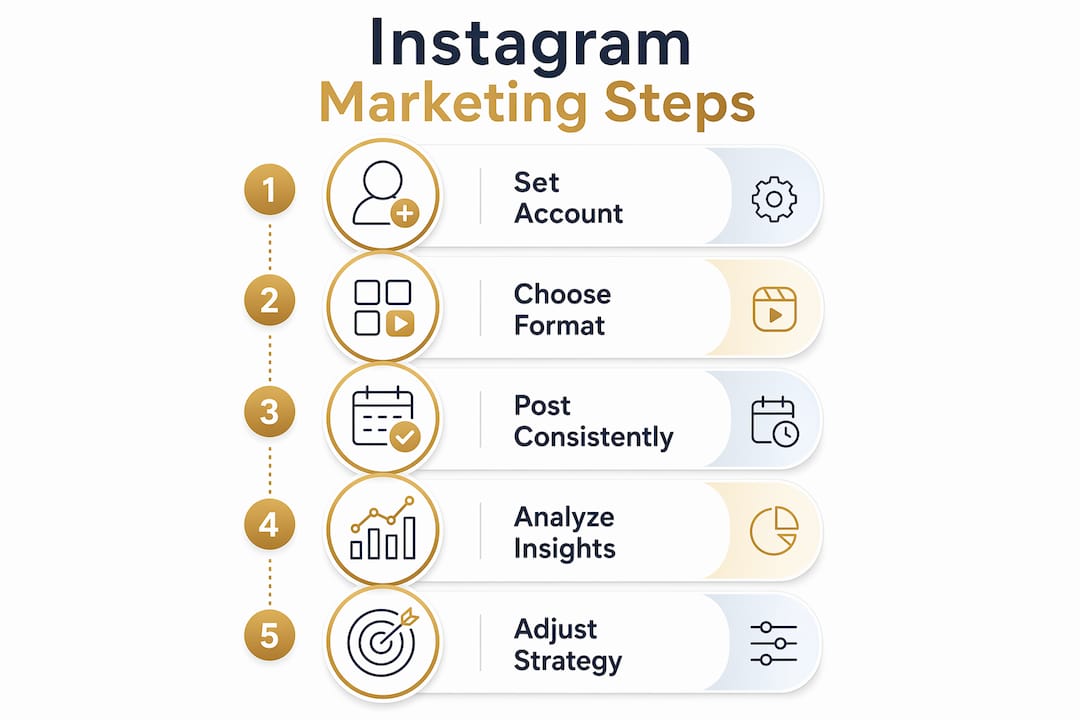
An Instagram marketing strategy is a documented plan that connects your business goals to specific content formats, posting schedules, and ad spend. Beginners succeed by aligning each content format to a specific business goal rather than posting randomly. Random posting produces random results.
Follow this framework to build your strategy:
- Set one primary goal per quarter. Examples: grow followers by 500, generate 20 direct message enquiries per month, or drive 100 website clicks per week.
- Define your audience. Age, location, interests, and the problems they are trying to solve. Instagram’s audience targeting in Meta Ads Manager mirrors this directly.
- Choose your content mix. A practical starting ratio for service businesses is two Reels per week, three to five Stories per day, and one Carousel per week.
- Build a content calendar. Plan content two weeks ahead. Use a simple spreadsheet or a tool like Later or Planoly to schedule posts.
- Review Insights every Monday. Identify what worked the previous week and replicate the format, topic, or caption style.
For community building, incorporating collaborators in posts can substantially increase reach, but the quality of your audience engagement matters more than raw follower numbers. One genuine comment from a potential customer is worth more than fifty passive likes.
Instagram does not operate in isolation. Pair your Instagram strategy with Google Ads for search intent traffic, SEO for long-term organic visibility, and email marketing for lead nurturing. Businesses that integrate Instagram into an omnichannel approach, rather than treating it as a standalone channel, generate more consistent leads and better return on ad spend. For a practical starting point, the social media marketing checklist at Jarrodharman covers the foundational steps across platforms.
Key takeaways
Effective Instagram marketing for beginners requires a business account, format-specific content strategy, data-driven decisions through Insights, and paid ads aligned to clear objectives.
| Point | Details |
|---|---|
| Switch to a business account first | A business account unlocks Insights, ads, shopping, and contact buttons in about five minutes. |
| Match content format to your goal | Use Reels for reach, Stories for retention, and Carousels for engagement and saves. |
| Read your Insights weekly | Track reach, engagement rate, and direct messages to identify what content actually drives enquiries. |
| Choose the right ad objective | Meta’s algorithm delivers results based on the objective you select, so mismatched objectives waste budget. |
| Integrate Instagram with other channels | Combining Instagram with SEO, Google Ads, and email marketing produces more consistent leads than any single channel alone. |
What I have learned from helping businesses start on Instagram
Most beginners spend the first three months on the wrong things. They obsess over follower counts, post inconsistently, and never look at their Insights. The businesses I have worked with that grow fastest on Instagram share one habit: they treat every post as a test and every week’s data as feedback.
The account setup step is genuinely underestimated. Switching to a business account and connecting it to Meta Ads Manager takes ten minutes and unlocks the entire advertising ecosystem. I have seen business owners spend months posting on a personal account and wondering why nothing is working. The tool is free. Use it.
On content, the temptation is to copy what larger brands do. That rarely works for a small or medium business starting out. What works is showing up consistently in the format your specific audience responds to, then doubling down on that format once your Insights confirm it. One client in the beauty industry grew her enquiry rate by posting three Reels per week for eight weeks, all shot on an iPhone, all under 60 seconds. No production budget. Just consistency and a clear message.
The integration point is where most beginners leave money on the table. Instagram is a discovery and trust-building channel. Pair it with a Google Ads campaign targeting high-intent search terms and an SEO strategy that captures organic traffic, and you have a system that generates leads from multiple directions simultaneously. That is the difference between a social media presence and a marketing system.
, Business Warriors | Digital Marketing Agency
Ready to build a marketing system that goes beyond Instagram?
Instagram is one piece of a larger puzzle. At Jarrodharman, the Marketing Vortex Method combines Instagram and social media marketing with SEO, Google Ads, Meta advertising, and email marketing into a single, integrated system built for service businesses. If you are serious about generating consistent leads and not just growing a following, this is the framework that connects every channel to a measurable outcome.
Whether you are just starting out or ready to scale, Jarrodharman’s social media lead generation strategies give you a proven path from first post to consistent client enquiries. Explore how the Marketing Vortex Method works for businesses like yours.
FAQ
What is Instagram marketing for beginners?
Instagram marketing for beginners is the practice of using Instagram’s business account features, content formats, and Meta advertising tools to grow brand awareness and generate leads. It starts with switching to a Business account and learning which content formats serve which goals.
How often should beginners post on Instagram?
Post two to three Reels per week, three to five Stories per day, and one Carousel per week as a starting framework. Instagram Stories reach peaks at around 13 slides per day, so avoid exceeding that volume.
Do I need to run ads to grow on Instagram?
Organic content builds your audience, but Meta Ads accelerate results significantly. Beginners should establish a consistent organic posting rhythm first, then add paid ads once they know which content resonates with their audience.
How long does Instagram Shopping approval take?
Instagram Shopping approval through Meta Commerce Manager typically takes one to seven business days. Preparing your product catalogue and compliance documents before submitting reduces the risk of delays.
How does Instagram fit into a broader SEO strategy?
Instagram drives social signals, brand awareness, and direct traffic, which support your overall digital presence. Pairing Instagram with an SEO strategy that targets search intent and a Google Ads campaign that captures high-intent queries creates a multi-channel system that generates leads consistently.