

Marketing a pharmacy in Australia: a complete 2026 guide
Marketing your pharmacy in Australia means navigating complex regulations while competing for local customers. Success requires understanding Pharmacy Board and TGA compliance frameworks, building a mobile-optimised digital presence, and deploying targeted local SEO, PPC, email, and social strategies. This guide walks you through proven, compliant marketing steps to increase pharmacy leads and sales in 2026.
Table of Contents
- Prerequisites: Compliance And Legal Requirements For Pharmacy Marketing In Australia
- Step 1: Build A Compliant, Mobile-Friendly Pharmacy Website
- Step 2: Implement Local SEO Strategically To Drive Foot Traffic
- Step 3: Launch Compliant Pay-Per-Click Advertising Campaigns
- Step 4: Leverage Email Marketing For Customer Retention And Re-Engagement
- Step 5: Build Patient Trust With Social Media Marketing
- Step 6: Integrate Omnichannel Advertising Strategies For Maximum Impact
- Common Mistakes And Troubleshooting In Pharmacy Marketing
- Expected Results And Measuring Success In Pharmacy Marketing
- Boost Your Pharmacy Marketing With Expert Digital Strategies
- Frequently Asked Questions
Key takeaways
| Point | Details |
|---|---|
| Compliance first | All pharmacy marketing must comply with Pharmacy Board and TGA regulations to avoid penalties and protect your licence. |
| Mobile and local SEO | Mobile-optimised websites and Google Business Profile optimisation drive 25% more bookings and significantly increase foot traffic. |
| Omnichannel amplification | Combining SEO, PPC, email, and social media raises lead generation by up to 40% with consistent, coordinated messaging. |
| Regular audits prevent mistakes | Content calendars and compliance audits stop costly errors; neglecting them halves customer engagement. |
| ROI timeline | Expect measurable returns within 3 to 6 months with consistent effort and budgets of $1,000+ monthly. |
Prerequisites: compliance and legal requirements for pharmacy marketing in Australia
Before launching any marketing campaign, pharmacy owners must understand the regulatory landscape. Pharmacy marketing in Australia is regulated by the Pharmacy Board and Therapeutic Goods Administration, requiring all advertisements to be truthful, not misleading, and compliant with the Health Practitioner Regulation National Law Act.
Every piece of content you publish must meet strict standards. Patient privacy and confidentiality are paramount. Your marketing cannot make unsubstantiated health claims or create unrealistic expectations about treatment outcomes.
Non-compliance carries serious consequences:
- Heavy financial penalties that can reach tens of thousands of dollars
- Risk to your pharmacy licence and professional registration
- Damage to patient trust and brand reputation
- Potential legal action from regulatory bodies
“Compliance is not optional in pharmacy marketing. It’s the foundation that protects your business, your patients, and your professional standing. Every marketing decision must pass the regulatory test first.”
Establishing a compliance review process before publishing any pharmacy marketing materials protects your investment. Work with legal advisors familiar with pharmacy regulations. Document your compliance checks. Keep records of all marketing approvals and modifications.
Consider creating a compliance checklist for every campaign. Include verification that claims are supported by evidence, disclosures are clear, and patient privacy protocols are followed. This systematic approach reduces risk and builds confidence in your pharmacy services marketing strategy.
With compliance frameworks clear, the next step is building a compliant, mobile-friendly website as the foundational marketing asset.
Step 1: build a compliant, mobile-friendly pharmacy website
Your pharmacy website serves as the digital front door to your business. Australian consumers predominantly use smartphones to search for health services, making mobile optimisation critical. Mobile-optimised pharmacy websites increase appointment bookings and online orders by 25% compared to non-optimised sites.

Start with responsive design that adapts seamlessly to any screen size. Pages must load in under three seconds to prevent visitor abandonment. Test your site on multiple devices and browsers regularly.
Essential website elements include:
- Clear navigation to services, contact information, and online booking
- Prominent display of operating hours and location with map integration
- Secure patient portals for prescription refills and appointment scheduling
- Visible privacy policies and security certifications
- Compliance-approved content with no misleading health claims
Your calls to action must be obvious and actionable. “Book Your Consultation,” “Order Prescription Online,” or “Find Your Nearest Location” buttons should stand out visually. Place them above the fold and repeat them throughout key pages.
Pro Tip: Add a live chat feature to answer patient questions immediately. This personal touch increases conversion rates by providing instant support when visitors are making decisions about their health needs.
Content must balance patient education with regulatory compliance. Avoid superlatives like “best” or “guaranteed” unless you can substantiate them. Focus on factual service descriptions, qualified staff credentials, and evidence-based health information.
Security is non-negotiable. Install SSL certificates to encrypt data transmission. Display trust badges prominently. Ensure your online booking and prescription systems meet Australian privacy standards.
Regularly audit your website for broken links, outdated information, and compliance issues. Update content to reflect current pharmacy marketing strategies and service offerings. Consider implementing an ecommerce SEO package to optimise product pages for search engines.
Once the website foundation is set, the guide moves to boosting local visibility through targeted SEO optimisation.
Step 2: implement local SEO strategically to drive foot traffic
Local search dominates pharmacy customer acquisition. When patients search “pharmacy near me” or “chemist open now,” you want your business appearing at the top. Strategic local SEO turns these searches into foot traffic and appointments.
Google Business Profile optimisation is your most powerful local SEO tool. Follow these steps:
- Claim and verify your Google Business Profile listing immediately
- Complete every profile section with accurate, detailed information
- Select relevant primary and secondary business categories
- Upload high-quality photos of your pharmacy interior, exterior, and staff
- Post regular updates about services, offers, and health tips
- Respond promptly to all patient reviews, both positive and negative
- Add special attributes like wheelchair accessibility and parking availability
Keyword research drives your local content strategy. Target pharmacy-related terms with local modifiers: “compounding pharmacy Perth,” “flu vaccines Sydney,” “diabetes supplies Melbourne.” Use these naturally in your website content, meta descriptions, and blog posts.
| Local SEO tactic | Impact on visibility | Implementation time |
|---|---|---|
| Google Business Profile optimisation | 35% increase in local search appearances | 2-4 hours initial setup |
| Local keyword integration | 28% boost in targeted traffic | Ongoing, 3-5 hours monthly |
| Citation building | 22% improvement in map rankings | 4-6 hours quarterly |
| Review generation | 40% higher click-through rates | Ongoing, 2 hours weekly |
Consistent NAP (name, address, phone) information across all online directories strengthens local rankings. Audit your listings on healthcare directories, review sites, and local business platforms. Correct any inconsistencies immediately.
Patient reviews significantly influence both search rankings and conversion decisions. Implement a systematic review request process. Send follow-up emails after appointments. Make it easy by providing direct links to your Google Business Profile.
Create location-specific content that answers local health concerns. Blog about seasonal health issues affecting your area. Highlight community health events you participate in. This geo-targeted content helps you rank for local searches while demonstrating community involvement.
For pharmacies with multiple locations, create separate SEO for local businesses strategies for each. Develop unique content for each location page highlighting specific services, staff, and community ties.
Monitor your local search performance through Google Search Console and Google Business Profile insights. Track impressions, clicks, direction requests, and phone calls. Adjust your strategy based on what drives the most valuable patient interactions.
Consistent local SEO efforts build sustainable visibility. Unlike paid advertising, these organic rankings continue delivering patients without ongoing costs. Combined with other pharmacy marketing tactics for leads and sales, local SEO creates a powerful patient acquisition engine.
With search visibility improved, launching paid advertising campaigns next accelerates lead generation effectively.
Step 3: launch compliant pay-per-click advertising campaigns
Pay-per-click advertising delivers immediate visibility and qualified leads when executed correctly. Pharmacy PPC campaigns typically achieve a 4.5% click-through rate and 8% conversion rate, making them highly effective for patient acquisition.
Google Ads requires careful compliance management for healthcare advertising. Your campaigns must adhere to both Google’s healthcare advertising policies and Australian regulatory requirements. Avoid making therapeutic claims or suggesting your pharmacy can cure specific conditions.
Effective pharmacy PPC strategies include:
- Geo-targeting to focus ad spend on patients within your service area
- Service-specific campaigns for flu vaccines, compounding, or diabetes management
- Time-based bidding to increase visibility during peak search hours
- Negative keywords to exclude irrelevant searches and protect budget
- Ad extensions showing location, phone number, and service links
Craft ad copy that focuses on convenience, service quality, and patient care rather than medical outcomes. “Expert Compounding Services in Perth” works better than “Cure Your Health Problems.” Highlight differentiators like extended hours, free delivery, or specialised services.
Pro Tip: Create separate campaigns for prescription services versus retail products. Prescription campaigns should focus on convenience and expertise, while retail campaigns can highlight competitive pricing and product selection. This segmentation improves relevance and quality scores.
Meta (Facebook and Instagram) advertising reaches patients during their daily social media browsing. These platforms allow sophisticated audience targeting based on demographics, interests, and behaviours. Target local residents interested in health and wellness topics.
Your Meta ads must be particularly careful about health claims. Focus on awareness and education rather than treatment promises. Promote services like health screenings, vaccination clinics, or wellness consultations without making outcome guarantees.
Track performance religiously. Monitor cost per click, conversion rates, and cost per acquisition. Set up conversion tracking for online bookings, phone calls, and form submissions. Use this data to optimise campaigns continuously.
A/B test everything. Try different headlines, descriptions, images, and calls to action. Small improvements in click-through and conversion rates compound over time, significantly improving campaign ROI.
Budget allocation matters. Start with modest daily budgets of $50 to $100 while testing and optimising. Scale spending once you identify winning campaigns with positive returns. Most successful pharmacy PPC accounts invest $1,000 to $3,000 monthly across Google and Meta platforms.
Integrate your PPC campaigns with other pharmacy advertising ideas for maximum impact. Ensure landing pages match ad messaging. Use retargeting to recapture visitors who didn’t convert initially.
Regular campaign audits identify wasted spend and optimization opportunities. Review search term reports to find new keywords and eliminate non-converters. Adjust bids based on performance data. Refresh ad creative every six to eight weeks to prevent ad fatigue.
Professional digital advertising media management ensures compliance while maximizing results. Expert campaign management pays for itself through improved efficiency and higher conversion rates.
Next, nurture customer relationships using email marketing to boost retention and repeat business.
Step 4: leverage email marketing for customer retention and re-engagement
Email marketing delivers exceptional ROI for pharmacy patient retention. Pharmacy email campaigns achieve average 25% open rates and 4% click-through rates, outperforming many other industries. This direct communication channel keeps your pharmacy top of mind between visits.
Segmentation transforms generic emails into personalised patient communications. Divide your list based on:
- Prescription refill schedules and medication types
- Interest in specific health conditions or wellness topics
- Purchase history and service preferences
- Engagement level with previous emails
- Demographic factors like age and location
Personalised emails generate significantly higher engagement than generic broadcasts. Address patients by name. Reference their specific interests or previous interactions. Send refill reminders timed to their medication schedules.
Your email content should educate, inform, and gently promote. Share seasonal health tips, new service announcements, and exclusive offers. Provide genuine value in every message to maintain subscriber interest and trust.
Effective pharmacy email types include:
- Prescription refill reminders with one-click reorder links
- Seasonal health campaigns for flu shots, allergy relief, or sun protection
- New product announcements for vitamins, supplements, or health devices
- Educational newsletters about managing chronic conditions
- Exclusive subscriber offers and loyalty program updates
Compliance extends to email marketing. Include clear unsubscribe options. Never share patient information without explicit consent. Avoid making therapeutic claims or guaranteeing health outcomes.
Email automation saves time while maintaining consistent patient contact. Set up welcome series for new subscribers, birthday greetings with special offers, and re-engagement campaigns for inactive patients. These automated touches nurture relationships without ongoing manual effort.
Test subject lines relentlessly. Your open rate depends entirely on whether the subject line captures attention. Try questions, urgency, personalisation, and benefit-focused approaches. A/B test every campaign to learn what resonates with your audience.
Mobile optimisation is critical since over 60% of emails are opened on smartphones. Use responsive templates. Keep subject lines under 40 characters. Design for thumb-friendly clicking with large buttons and clear calls to action.
Track key metrics to optimise performance: open rates, click-through rates, conversion rates, and unsubscribe rates. Identify your best-performing content and replicate that success. Remove or re-engage subscribers who haven’t opened emails in six months.
Email marketing can boost repeat visit rates by up to 20% through consistent, valuable communication. Combined with social media growth strategies and other channels, email creates multiple touchpoints that keep patients engaged.
Integrate email with your broader lead generation strategies online by using emails to promote your blog content, social media channels, and special events. This cross-channel promotion amplifies reach and reinforces messaging.
Building trust on social media further strengthens patient relationships and brand differentiation.
Step 5: build patient trust with social media marketing
Social media transforms your pharmacy from a transactional service into a trusted health partner. Patient testimonials and educational content on social platforms increase engagement by 35%, building community connections that drive loyalty and referrals.
Choose platforms where your patients spend time. Facebook reaches older demographics interested in health information. Instagram works well for visual health tips and behind-the-scenes pharmacy content. LinkedIn connects with corporate clients for workplace health programs.
Educational content establishes your expertise and provides genuine value. Share:
- Medication safety tips and proper storage information
- Seasonal health advice for cold prevention, sun safety, or allergy management
- Explanations of common health conditions in plain language
- Nutrition and wellness tips that complement pharmaceutical care
- Updates about new services or extended hours
Patient testimonials and success stories humanise your pharmacy. Share reviews (with permission) highlighting exceptional service, convenient locations, or helpful staff. Video testimonials carry even more impact than text reviews.
Consistency matters more than frequency. Posting three quality posts weekly beats daily low-value content. Develop a content calendar planning posts around health awareness days, seasonal topics, and pharmacy events.
Engagement builds community. Respond promptly to comments and messages. Answer health questions within your scope of practise. Direct complex medical queries to appropriate healthcare providers. This responsiveness demonstrates patient care beyond the counter.
Transparency and compliance protect your reputation. Clearly label promotional content. Disclose any partnerships or sponsorships. Never violate patient privacy by sharing identifiable information without explicit written consent.
Visual content dramatically outperforms text-only posts. Use high-quality photos of your pharmacy, staff, and products. Create simple infographics explaining health concepts. Short videos showing compounding processes or staff introductions connect personally with followers.
Paid social advertising extends your organic reach. Boost high-performing posts to local audiences. Run targeted campaigns for specific services like flu vaccination clinics. Use retargeting to stay visible to people who’ve visited your website.
Monitor social metrics to understand what resonates. Track engagement rates, follower growth, reach, and click-throughs to your website. Double down on content types that generate conversation and shares.
User-generated content amplifies your message authentically. Encourage patients to share their positive experiences and tag your pharmacy. Repost these authentic testimonials (with permission) to build social proof.
Social listening identifies community health concerns and conversation topics. Use this insight to create timely, relevant content that addresses current patient needs. This responsiveness positions your pharmacy as attentive and caring.
Combine social media with other channels for maximum impact. Promote your email newsletter signup on social platforms. Share blog posts and drive traffic to your website. Cross-promote across multiple social channels to expand reach.
Professional social media marketing for beginners guidance accelerates results. Expert management ensures consistent, compliant posting while you focus on patient care. Advanced social media listening for client acquisition uncovers opportunities competitors miss.
Integrating all channels creates a powerful omnichannel marketing approach amplifying lead generation results.
Step 6: integrate omnichannel advertising strategies for maximum impact
Omnichannel marketing coordinates all your advertising channels into a unified strategy that increases lead generation by 40%. Rather than running disconnected campaigns, integration creates synergies where each channel amplifies the others.
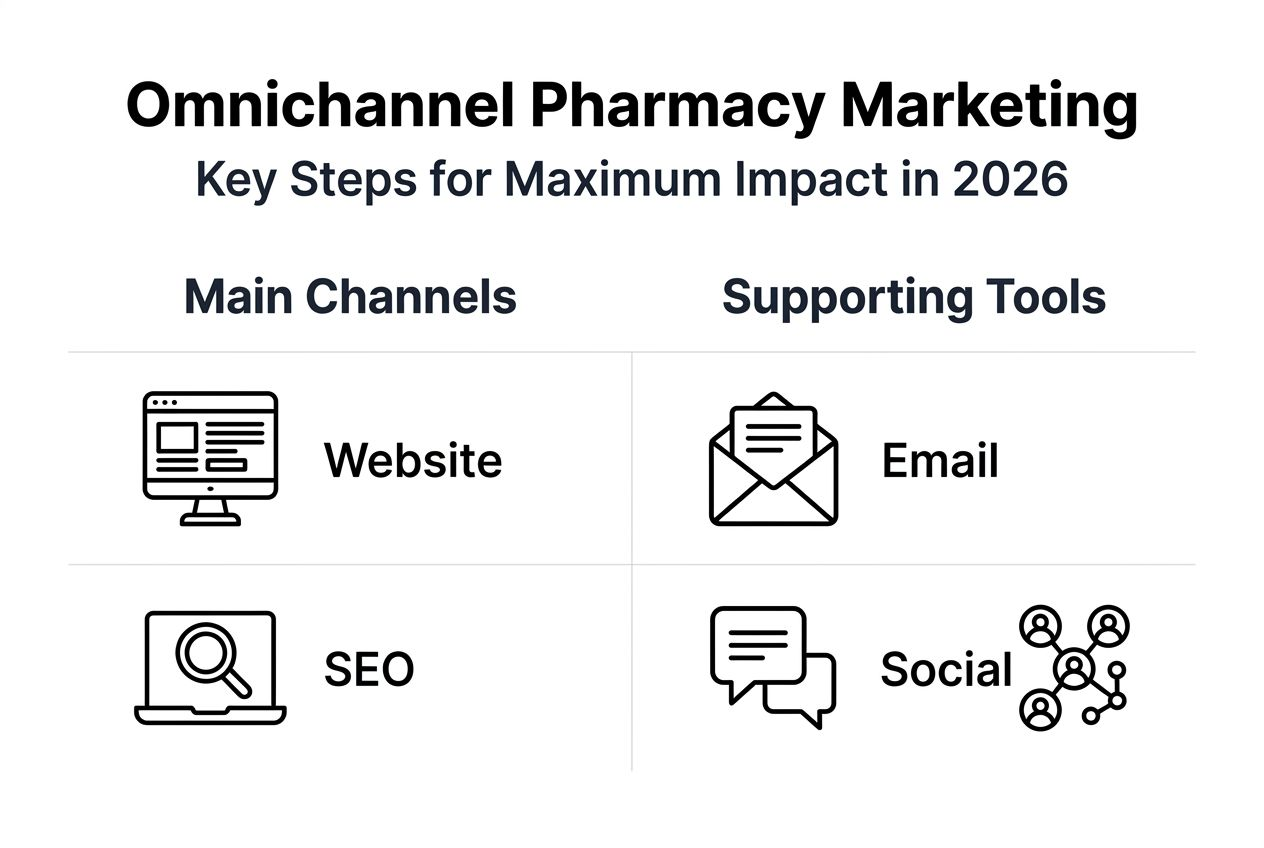
The power of omnichannel lies in consistent messaging across touchpoints. A patient might discover your pharmacy through Google search, visit your website, see your Facebook ad, receive an email reminder, and finally book an appointment. Each interaction reinforces your brand and moves them closer to conversion.
Strategic channel coordination includes:
- Using SEO insights to inform PPC keyword targeting
- Retargeting website visitors with social media ads
- Promoting email content through social media posts
- Driving social followers to subscribe to your email list
- Creating blog content that supports both organic and paid search
Risk diversification protects your patient acquisition. Relying solely on one channel leaves you vulnerable to algorithm changes, policy updates, or competitive pressure. Spreading efforts across multiple channels ensures consistent lead flow even when individual channels fluctuate.
| Marketing channel | Primary benefit | Lead generation contribution | Integration point |
|---|---|---|---|
| Local SEO | Sustainable organic visibility | 30% of total leads | Informs content for all channels |
| PPC advertising | Immediate qualified traffic | 25% of total leads | Retargets SEO visitors |
| Email marketing | Patient retention and repeat visits | 20% of total leads | Promotes social content |
| Social media | Community building and trust | 15% of total leads | Drives email signups |
| Content marketing | Authority and education | 10% of total leads | Supports SEO and social |
Campaign coordination requires planning. Align messaging across channels around key themes like seasonal health, new services, or community events. A flu vaccination campaign should feature consistent visuals, offers, and calls to action whether patients encounter it through search, social, or email.
Data integration provides comprehensive performance insights. Connect Google Analytics, ad platforms, email metrics, and social analytics. Track the complete patient journey from first touch to conversion. Understand which channel combinations drive the best results.
Budget allocation should reflect performance data. Invest more in channels delivering strong ROI while maintaining presence across all platforms. Typical successful distribution allocates 35% to SEO and content, 30% to PPC, 20% to social media, and 15% to email marketing.
Timing coordination maximises impact. Launch PPC campaigns to capture immediate demand while SEO builds. Use email to nurture leads generated through paid channels. Retarget engaged email subscribers with social ads featuring special offers.
Omnichannel success requires coordinated management. Siloed teams running independent campaigns miss integration opportunities. Centralised strategy ensures all channels work together toward common goals.
Advanced pharmacy conversion strategies optimize each touchpoint in the patient journey. Professional pharmacy marketing company guidance implements sophisticated integration most pharmacy owners lack time to manage themselves.
Measure overall marketing effectiveness, not just individual channel metrics. Track total lead volume, cost per acquisition across all channels, patient lifetime value, and marketing ROI. These holistic metrics reveal true campaign performance.
Understanding these advanced strategies, it is vital to recognise and fix common marketing mistakes to maintain compliance and effectiveness.
Common mistakes and troubleshooting in pharmacy marketing
Even well-intentioned pharmacy marketing campaigns fall into predictable traps. Understanding these mistakes helps you avoid costly errors that waste budget and risk compliance violations.
Compliance negligence tops the list of dangerous mistakes. 34% of pharmacies lose leads due to non-compliance delays. Making unsubstantiated health claims, violating patient privacy, or ignoring advertising regulations can result in severe penalties and licence suspension. Every campaign must pass regulatory review before launch.
Inconsistent content scheduling undermines engagement. Neglecting content calendars reduces engagement by 50% according to compliance research. Posting sporadically confuses patients and damages brand reliability. Develop and follow a consistent publishing schedule across all channels.
Common pharmacy marketing mistakes include:
- Non-mobile-optimised websites that reduce conversions by 25%
- Poor geo-targeting that wastes advertising budget on irrelevant audiences
- Generic messaging that fails to differentiate from competitor pharmacies
- Ignoring patient reviews and online reputation management
- Failing to track and measure campaign performance
- Mixing promotional and educational content inappropriately
Website neglect costs opportunities daily. Slow loading times, broken links, and outdated information frustrate visitors. Regular site audits identify and fix technical issues before they impact patient experience and search rankings.
Pro Tip: Schedule monthly compliance audits of all marketing materials. Review website content, social media posts, email campaigns, and paid ads. Document the review process and any changes made. This systematic approach prevents violations and creates accountability.
Poor targeting wastes advertising budget. Running Google Ads without location restrictions or demographic targeting generates clicks from people who’ll never become patients. Tight geo-targeting and audience segmentation ensure you reach qualified prospects.
Neglecting analytics means flying blind. Without tracking website traffic, conversion rates, and campaign ROI, you can’t identify what works or optimize underperforming efforts. Implement comprehensive tracking and review metrics weekly.
Inconsistent branding confuses patients across channels. Your website, social media, emails, and ads should have cohesive visual identity and messaging. Brand consistency builds recognition and trust.
Ignoring negative reviews damages reputation. Every review, positive or negative, deserves a professional response. Address complaints promptly and publicly to demonstrate patient care. Most potential patients read reviews before choosing a pharmacy.
Failing to build email lists early costs long-term opportunities. Every website visitor and in-store customer represents a potential subscriber. Implement email capture at every touchpoint to build your database for future marketing.
Overcomplicating messaging reduces effectiveness. Patients want clear, simple information about services, hours, and how to access care. Avoid medical jargon and focus on patient benefits in plain language.
Many pharmacies make the mistake of copying competitor strategies without understanding their own unique value proposition. Identify what makes your pharmacy special and build marketing around those differentiators.
Regular strategy reviews prevent stagnation. Market conditions, patient needs, and competitive landscapes change constantly. Quarterly strategic reviews ensure your marketing evolves with your business environment.
Professional guidance helps avoid these pitfalls. Expert marketers familiar with digital marketing mistakes to avoid and healthcare marketing compliance guide you around common traps while optimising for results.
With these pitfalls addressed, finalising the guide with realistic success metrics and timelines completes the marketing roadmap.
Expected results and measuring success in pharmacy marketing
Realistic expectations prevent frustration and guide strategic decisions. Pharmacy digital marketing typically achieves measurable ROI within 3 to 6 months of consistent, coordinated effort. Understanding timelines and metrics helps you evaluate success accurately.
Budget significantly impacts results. Monthly marketing investments of $1,000 or more yield better outcomes than minimal spending. Larger budgets support multi-channel presence, professional content creation, and sustained advertising reach. Smaller budgets require more focused strategies and longer timelines.
Key performance indicators to track:
- Website traffic volume and source breakdown
- Local search ranking positions for target keywords
- Google Business Profile impressions and actions
- PPC click-through rates and conversion rates
- Email open rates, click rates, and unsubscribe rates
- Social media engagement, reach, and follower growth
- Overall lead volume and cost per acquisition
- Patient lifetime value and retention rates
Different channels deliver results on different timelines:
| Marketing activity | Time to initial results | Time to significant ROI | Key success metric |
|---|---|---|---|
| Google Business Profile optimisation | 2-4 weeks | 2-3 months | Direction requests and calls |
| Local SEO content | 6-12 weeks | 4-6 months | Organic search rankings |
| PPC advertising | Immediate | 4-8 weeks | Cost per conversion |
| Email marketing | 2-4 weeks | 2-3 months | Repeat visit rate |
| Social media organic | 8-12 weeks | 6-9 months | Engagement rate |
Early indicators predict long-term success. Increasing website traffic, growing email subscribers, and improving local search visibility signal effective strategies. Monitor these leading indicators to stay on track.
Conversion rate optimisation compounds results over time. Small improvements in website conversion, email click-through, or ad performance create significant ROI gains. A pharmacy converting 3% of website visitors who improves to 4% generates 33% more leads from the same traffic.
Patient lifetime value justifies marketing investment. Acquiring a patient who visits monthly for prescriptions and purchases over-the-counter products generates substantial long-term revenue. Calculate lifetime value to understand acceptable acquisition costs.
Seasonal variations affect pharmacy marketing performance. Flu season drives higher search volume and conversion rates for vaccination services. Summer may see increased demand for travel health consultations. Plan campaigns around these predictable patterns.
Competitive markets require more aggressive investment. Pharmacies in saturated urban areas need larger budgets and more sophisticated strategies than those in underserved locations. Benchmark your performance against local competitors, not national averages.
Continuous optimisation drives improvement. Monthly performance reviews identify winning tactics to scale and underperformers to adjust or eliminate. Marketing is iterative; each campaign informs and improves the next.
Professional measurement and reporting provide clarity. Expert analysis identifies opportunities in your data that internal teams might miss. Understanding what works allows strategic reinvestment for maximum growth.
Realistic goals keep teams motivated and focused. Aim for 10-15% monthly growth in key metrics rather than unrealistic overnight transformations. Steady progress compounds into significant results over six to twelve months.
Document everything. Track which strategies generated which results. Record what worked, what failed, and why. This institutional knowledge prevents repeating mistakes and helps replicate successes.
Patience combined with persistent optimisation delivers results. Pharmacy marketing success comes from sustained, strategic effort rather than quick fixes. Commit to the process and measure progress objectively.
Integrate insights across channels. Notice that patients finding you through organic search convert better than paid traffic? Increase SEO investment. Discover email subscribers have higher lifetime value? Prioritise list building. Let data guide resource allocation.
Comprehensive tracking through tools like Google Analytics, call tracking software, and CRM systems provides complete performance visibility. Understand the entire patient journey from first awareness to loyal customer.
Success in pharmacy marketing means sustainable patient acquisition at acceptable costs, building long-term relationships, and growing your business profitably. Focus on these outcomes rather than vanity metrics like social media followers or website traffic alone.
Professional guidance accelerates results. Expert strategists help pharmacies implement proven systems, avoid common mistakes, and achieve ROI faster. Lead generation campaign expertise and systematic digital marketing for measurable growth transform marketing from expense to investment.
After establishing metrics, the article transitions to connect readers with expert marketing services to help execute these strategies.
Boost your pharmacy marketing with expert digital strategies
Executing a comprehensive pharmacy marketing strategy while managing daily operations challenges even the most organised owners. Professional marketing support ensures regulatory compliance, strategic coordination, and optimised performance across all channels.
Business Warriors specialises in pharmacy marketing throughout Australia. Our Marketing Vortex method integrates SEO, PPC, email marketing, social media, and web development into coordinated campaigns that amplify results. We understand pharmacy-specific compliance requirements and build strategies that attract patients while protecting your licence.

Our proven approach combines technical expertise with deep understanding of patient decision-making. We create mobile-optimised websites, manage compliant advertising campaigns, and develop content that educates while converting. Every strategy is tailored to your specific services, location, and growth goals.
Free consultations help pharmacy owners understand their current marketing gaps and opportunities. We analyse your digital presence, competitive landscape, and growth potential, then recommend actionable strategies. Whether you need comprehensive SEO consultant support in Perth or specific campaign management, we provide solutions that deliver measurable results.
Our clients typically see ROI within 3 to 6 months. We focus on sustainable growth through digital marketing step by step approaches that build long-term patient relationships. Transparent reporting keeps you informed of progress and performance.
Explore comprehensive pharmacy marketing strategies for Australia designed specifically for service-based businesses. Our team manages the complexity while you focus on patient care.
To address specific concerns, we conclude with a FAQ section answering common pharmacy marketing questions.
Frequently asked questions
What is the most important compliance rule for pharmacy marketing in Australia?
Pharmacy advertising must comply with Pharmacy Board and TGA rules, ensuring all claims are truthful and non-misleading as mandated by the Health Practitioner Regulation National Law Act. Never make unsubstantiated health claims or guarantee treatment outcomes. Patient privacy must be protected in all marketing materials, and therapeutic claims require appropriate evidence and disclaimers.
How long does it usually take to see results from pharmacy digital marketing?
Typically 3 to 6 months to see measurable return on marketing investment with consistent multi-channel effort. PPC campaigns deliver immediate traffic but require 4 to 8 weeks to optimise conversion rates. SEO and content marketing build momentum over 6 to 12 weeks before generating significant organic traffic. Email marketing shows engagement within 2 to 4 weeks but builds retention value over months.
What role does email marketing play in retaining pharmacy customers?
Email marketing keeps patients engaged with personalised offers, prescription refill reminders, and valuable health information. Segmented campaigns addressing specific patient needs achieve 25% open rates and boost repeat visit rates by up to 20%. Automated email sequences nurture relationships without ongoing manual effort, making email one of the most cost-effective retention channels for pharmacies.
What common mistakes should pharmacists avoid in digital marketing?
Ignoring compliance regulations and skipping content scheduling cause the most damage, losing up to 34% of potential leads through delays and halving customer engagement. Non-mobile-optimised websites reduce conversions by 25%. Poor geo-targeting wastes advertising budget on irrelevant audiences. Use compliance audits and content calendars to stay on track, and invest in mobile-responsive design from the start.
Recommended
- Marketing for pharmacy Australia 2026: boost leads by 30% – Jarrod Harman
- Pharmacy marketing strategies Australia 2026: boost sales – Jarrod Harman
- Marketing Pharmacy in Australia 2026: 30% More Leads & Sales – Jarrod Harman
- Marketing Pharmacy Services Australia 2026: 40% Growth – Jarrod Harman
- Marketing Trends in 2025: Essential Guide for SMBs – Go Online Now