


TL;DR:
- Digital marketing for service businesses requires a connected system of specialised functions that attract, nurture, and convert clients effectively. Relying solely on channels like SEO, ads, or social media without integration leads to wasted budget and missed growth opportunities. Building a strategic, staged funnel with targeted nurturing can significantly improve client acquisition and retention over time.
Most service business owners assume digital marketing means posting regularly on Instagram and maybe running a few ads. That assumption costs them thousands in wasted budget every year. The reality is that digital marketing explained is an interconnected system of specialised functions, each with a distinct role in attracting, nurturing, and converting the right clients. If even one function is missing or misaligned, the whole engine stalls. This guide breaks down every essential function, shows you exactly where it fits in your client journey, and gives you a practical framework for making them all work together.
Table of Contents
- What are the essential digital marketing functions?
- Mapping functions to the client acquisition funnel
- Lead nurturing mechanics: How to make more prospects convert
- Analytics and conversion optimisation for non-linear service journeys
- Why a system, not just channels, is the real digital advantage
- Take the next step: Expert help for your digital marketing system
- Frequently asked questions
Key Takeaways
| Point | Details |
|---|---|
| Digital marketing functions | Understanding each function helps target your efforts and avoid wasted spend. |
| Funnel alignment | Map each digital activity to TOFU, MOFU, or BOFU for more predictable client growth. |
| Lead nurturing matters | Personalised, timely nurture workflows convert more prospects into clients. |
| Non-linear journeys | Service client paths aren’t straight lines, so analytics must reflect real behaviour. |
| Systems beat tactics | Coordinating your digital marketing as a system delivers stronger results than isolated efforts. |
What are the essential digital marketing functions?
After outlining how digital marketing is a complex system, let’s get clarity on the foundational blocks that actually move clients from strangers to paying customers.
Digital marketing services for a service-based business span core channels including SEO, paid search, paid social, content marketing, and email, plus measurement and conversion rate optimisation (analytics/CRO). Each function has a specific job to do. Treating them as interchangeable is like sending your receptionist to perform a treatment because they’re both “in the business.” The roles simply don’t overlap that cleanly.
Here’s a quick comparison of the major functions and how they serve you:
| Function | Primary purpose | Key metric | ROI timeframe | Best funnel stage |
|---|---|---|---|---|
| SEO | Organic visibility and authority | Organic sessions, rankings | 3 to 12 months | TOFU |
| Google Ads | Capture high-intent search demand | Cost per lead, ROAS | Immediate | BOFU |
| Meta/Facebook Ads | Awareness and interest generation | CPM, link clicks | 1 to 4 weeks | TOFU/MOFU |
| Content marketing | Educate and build trust | Time on page, shares | 2 to 6 months | MOFU |
| Email marketing | Nurture and re-engage leads | Open rate, click rate | 2 to 8 weeks | MOFU/BOFU |
| Analytics/CRO | Identify drop-offs and improve conversions | Conversion rate, bounce rate | Ongoing | All stages |
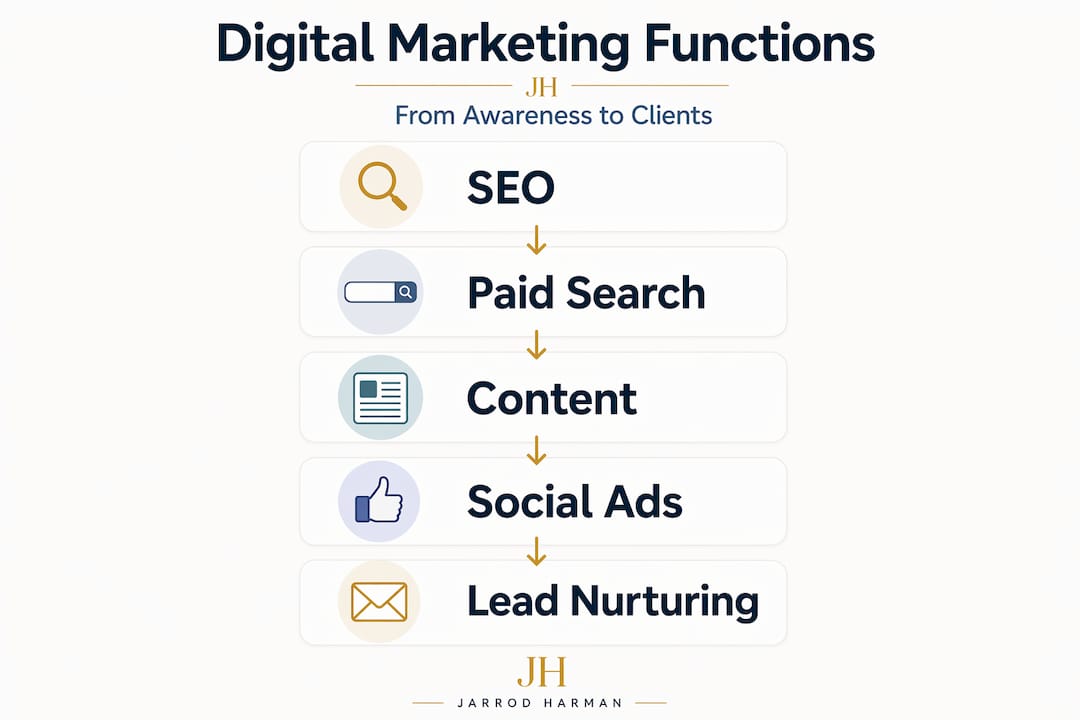
Understanding this table is genuinely powerful because it shows you at a glance that no single channel does everything. You need awareness channels and conversion channels working simultaneously.
Some of the most damaging myths service owners carry into their marketing are surprisingly common. Here’s what we hear most often, and why each belief holds businesses back:
- “SEO is too slow to bother with” — slow to start, yes, but it compounds over time and delivers the lowest cost per lead of any channel once it gains momentum.
- “Email is dead” — email still generates some of the highest returns of any digital channel, especially for service businesses where relationships drive bookings.
- “Paid ads are enough on their own” — ads bring traffic, but without content and nurture to support the decision, paid traffic often bounces without converting.
- “Social media is a vanity exercise” — organic social builds trust signals that dramatically improve the performance of your paid campaigns.
- “Analytics is for big businesses” — small service businesses are actually the ones who benefit most from knowing their exact drop-off points.
The key insight is that these functions interlock. Understanding marketing funnel basics shows you how every channel serves a different moment in your client’s decision-making process, and why cutting any of them prematurely creates gaps that quietly kill growth.
Mapping functions to the client acquisition funnel
Now that you know the core functions, let’s see how they actually fit into your client journey from first touch to signed contract.

Lead generation funnels for client acquisition should be organised into distinct funnel stages, each with specific mechanics driving the right behaviour at the right time. The three stages are TOFU (top of funnel), MOFU (middle of funnel), and BOFU (bottom of funnel). Think of them this way: TOFU is about being discovered, MOFU is about being trusted, and BOFU is about being chosen.
For a beauty clinic, TOFU might be a Meta ad or a blog post about skincare treatments reaching someone who has never heard of you. MOFU is a follow-up email sequence that educates that person about why your approach is different. BOFU is a Google Ad they click when they search “laser treatment near me” three weeks later, ready to book.
| Funnel stage | Goal | Best-fit functions | Example for service businesses |
|---|---|---|---|
| TOFU | Awareness and reach | SEO, Meta Ads, social media, content | Blog posts, Instagram Reels, Google Discovery ads |
| MOFU | Education and trust-building | Email, content, retargeting, webinars | Lead magnets, email sequences, case study videos |
| BOFU | Decision and conversion | Google Ads, landing pages, CRO | Service pages, booking forms, review highlights |
Here’s a step-by-step approach to aligning your marketing activity with funnel progression:
- Audit what you currently have by listing every channel you’re active on and marking it TOFU, MOFU, or BOFU. Most businesses discover they’re heavily weighted in one area.
- Identify your biggest gap. If you have TOFU traffic but low conversions, your MOFU nurture is probably broken. If conversions are fine but volume is low, your TOFU reach is the weak link.
- Assign specific goals and messages to each stage so your content and ads speak to where the prospect actually is mentally, not where you want them to be.
- Build bridges between stages using retargeting, trigger-based emails, and remarketing lists to move prospects forward without losing them in the gaps.
- Track stage-specific metrics rather than looking only at final sales, so you can see exactly where the funnel is healthy and where it leaks.
Pro Tip: Most service businesses stall because they focus almost entirely on TOFU (trying to get more eyeballs) or BOFU (chasing people ready to buy right now). Real, sustainable growth comes from strengthening MOFU, the trust-building middle that converts curious strangers into warm leads who are almost ready to commit. For a deeper look at building this out, consistent lead generation resources are well worth bookmarking, and walking through how to create a sales funnel step by step gives you a solid implementation framework.
Lead nurturing mechanics: How to make more prospects convert
After understanding the flow, you need to know what actually happens between “first contact” and “client signed,” which is entirely about how you nurture intent before it cools.
Here’s the uncomfortable truth. Most leads aren’t ready to buy immediately. Research consistently shows that the majority of service leads require multiple touchpoints before committing. The gap between “I’m interested” and “I’m booking” is filled by three barriers: timing (they’re not ready yet), information gaps (they still have unanswered questions), and trust (they’re not sure you’re the right choice). Your nurture system has to address all three, not just one.
Effective lead nurturing is triggered by behaviour, not just time. The most impactful nurture triggers for service businesses include:
- A prospect visits your pricing or services page more than once without booking
- Someone downloads a lead magnet or guide from your website
- A prospect attends a free workshop, webinar, or consultation but doesn’t convert
- An enquiry form is submitted but a booking is not made within 48 hours
- A client who booked previously hasn’t returned within a window you’d normally expect
Lead nurturing best practices make clear that triggered workflows and role-appropriate timing consistently outperform generic, one-size-fits-all email sequences. A beautician who sends the same weekly newsletter to a cold prospect and a warm lead who visited the booking page three times is missing a massive opportunity to personalise and convert.
Short, personal-sounding communications almost always outperform elaborate automated campaigns. A single sentence email that says “Hey, I noticed you checked out our treatments page. Happy to answer any questions you have before you book,” will outperform a five-email “welcome sequence” template that was never tailored to the reader’s actual behaviour.
“The businesses that win at lead nurturing aren’t the ones with the most sophisticated automation. They’re the ones who respond to real intent signals with relevant, timely communication that feels personal, not automated.” — Experienced digital strategist perspective from working with service businesses across Australia.
Pro Tip: Set up at minimum three behaviour-triggered email workflows: one for pricing page visitors who haven’t booked, one for enquiry form submissions that went cold, and one for past clients who are overdue for a return visit. These three alone can significantly recover lost revenue without spending a single dollar more on advertising.
For practical guides on this, explore how to nurture leads online and strengthen your wider lead generation strategies with approaches that go beyond passive waiting.
Analytics and conversion optimisation for non-linear service journeys
Once your nurturing is set, you need your analytics to tell you the truth about what’s working and what isn’t, especially because service buyers don’t follow a straight line.
Traditional linear funnel dashboards show you a neat progression: visitor, lead, opportunity, sale. The problem? Real service clients don’t behave that way. They visit your site, leave, come back from a Google Ad, read a blog post, visit your Instagram, come back again from an email, and then book. A linear report misses most of that journey and often gives you false confidence about which channels are actually doing the heavy lifting.
GA4 Path Exploration is specifically designed to account for non-linear journeys. Unlike traditional funnel analysis, it reveals what clients actually do on your site rather than what you assumed they would do. This distinction is critical for service businesses where the decision cycle often spans days or weeks, not minutes.
Common paths where drop-offs occur most often in service business websites include:
- Homepage to services page to exit — often indicates that service descriptions aren’t compelling enough or pricing is creating friction without enough supporting context.
- Blog post to homepage to exit — the content is attracting the right traffic but the pathway to conversion (contact, booking, enquiry) is unclear or buried.
- Pricing page to contact page to exit — usually signals that the enquiry form is too long, too generic, or there’s no reassurance (like reviews or guarantees) near the call to action.
- Ad landing page to homepage to exit — the landing page message and the homepage message are misaligned, causing confusion and breaking trust.
The process to fix this is straightforward. First, use GA4 Path Exploration to identify your three most common exit points. Second, form a hypothesis for why people leave at that point. Third, make one change to test your hypothesis. Fourth, measure for two to four weeks before drawing conclusions. Small, consistent improvements compound quickly.
Resources on how to optimise sales funnels and practical website conversion tips give you specific actions you can take based on what your data reveals.
Why a system, not just channels, is the real digital advantage
Now that you’ve seen how each function fits, let’s step back and debunk some persistent myths about how to put digital marketing to work for your business.
We see it constantly. A business owner reads that TikTok is booming, so they start posting there. Then they hear Google Ads are the fastest path to leads, so they launch a campaign. Then someone mentions a podcast, and they start planning that too. Within six months, they’re active across six channels, mediocre on all of them, and wondering why their pipeline is still unpredictable. This is the “channel dabbling” trap, and it quietly drains time, money, and morale.
The businesses that grow consistently are the ones that sequence their functions strategically. They build awareness first, then create trust pathways, then optimise conversion. Each function hands the prospect to the next stage deliberately, not by accident. When SEO brings a visitor in, email picks up the follow-up. When the email warms the lead, a retargeting ad nudges them back at the right moment. When they return ready to book, a clean, fast, well-structured booking page seals the deal.
Conversion rates don’t skyrocket because you spend more. They skyrocket because each function does its specific job and then hands over to the next one cleanly. Think of it like a relay race. Even if you have fast runners, a dropped baton loses the race every time.
The digital branding tips that separate high-growth service businesses from stagnant ones consistently point to integration and sequencing over volume and variety. More channels without a clear handover system creates noise, not momentum.
Pro Tip: Shift your thinking from “which channel should I use?” to “which function am I missing in my client journey right now?” That single reframe moves you from chasing tactics to building a system. For a deeper look at where this is heading, exploring lead nurturing for 2026 will give you a forward-looking edge on how to position your business for stronger client acquisition in the year ahead.
Take the next step: Expert help for your digital marketing system
Ready to stop guessing and start growing? Here’s how we help service businesses like yours connect every digital marketing dot.
At Business Warriors, we don’t sell you individual channels and hope for the best. Our 360° marketing method is built around connecting your awareness, nurture, and conversion functions into a single, measurable system that generates consistent bookings. Whether you’re ready to review your current digital marketing strategy or want a clear plan for scaling digital marketing and winning more clients, we’re here to show you exactly where to focus and what to do next. Book a consult with our team and let’s build your marketing system properly.
Frequently asked questions
What is the most important digital marketing function for service businesses?
The most important function is the one addressing your biggest current bottleneck, which for most service businesses is lead nurturing or conversion optimisation. Triggered workflows built around real prospect behaviour consistently deliver stronger results than simply increasing ad spend.
How do I know if my digital marketing funnel has gaps?
Use GA4 Path Exploration to see where visitors actually drop off or loop back, which tells you far more than a standard linear funnel report about where your nurture and conversion functions need strengthening.
How can I align my marketing with my sales process?
Map every marketing activity to a TOFU, MOFU, or BOFU stage so each channel fits its proper role in the client journey. Funnel stage mechanics ensure prospects receive the right message at the right moment rather than being pushed to convert before they’re ready.
Why is lead nurturing different for service-based vs retail businesses?
Services require a longer trust-building process because clients are buying expertise and outcomes, not just products they can return. Role-appropriate timing and behaviour-triggered communication are far more effective than generic automated sequences for building the confidence that drives a service booking.