27 May 2026
How to make money marketing online in 2026
Discover how to make money marketing online in 2026 with proven strategies. Learn effective SEO, email marketing, and more! Start earning now!
TL;DR:
- Most aspiring online marketers fail because they lack a structured approach rather than effort.
- Focusing on building a website, email list, and understanding their audience is essential before investing in ads.
Most people who try to make money marketing online never get past the dabbling stage. They jump between tactics, chase algorithm trends, and burn through their budget before anything compounds. The frustrating part is that it is not a lack of effort that stops them. It is a lack of structure. This guide cuts through the noise and shows you the proven methods that actually generate income: SEO, AI content systems, email marketing, paid advertising on Google and Meta, and affiliate strategies that build on each other rather than compete for your attention.
Table of Contents
- Key takeaways
- How to make money marketing online: the foundations
- Step-by-step income strategies that actually work
- AI, SEO, and getting found in 2026
- Measuring results and scaling your income
- My honest take on building income through online marketing
- Ready to grow your marketing income faster?
- FAQ
Key takeaways
| Point | Details |
|---|---|
| Build foundations first | Own your website, set up email marketing, and understand your audience before spending on ads. |
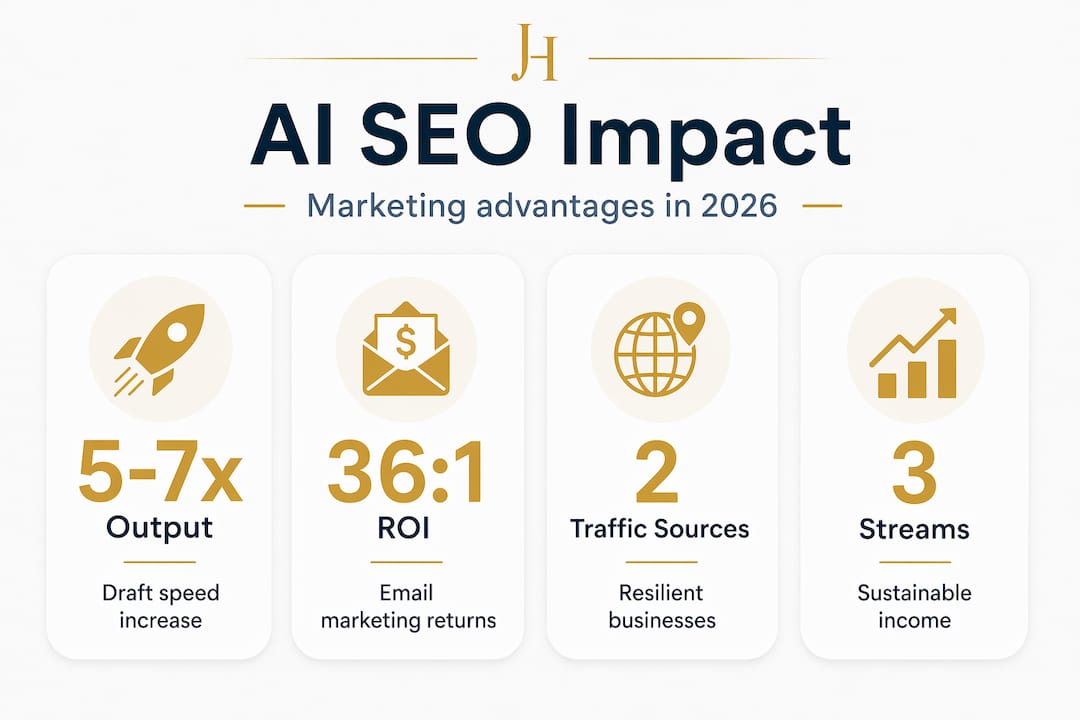
| Email beats every channel | Email delivers 36:1 ROI, making list-building your single highest-return activity from day one. |
| AI speeds up content creation | AI tools cut writing time by up to 7x, but human expertise is still what makes content trustworthy. |
| Track what drives revenue | Focus on lead conversion rate, average order value, and ad ROI rather than raw traffic counts. |
| Patience is the strategy | Affiliate income and SEO rankings typically take 3 to 6 months to build. Staying consistent is the actual edge. |
How to make money marketing online: the foundations
Before you spend a single dollar on ads or write a single article, you need three things in place: a home base, a way to capture leads, and a clear picture of who you are selling to. Skipping this step is the single most common reason aspiring marketers fail within 90 days.
Your website is non-negotiable. Social media platforms can throttle your reach, change their algorithms, or ban accounts without warning. Your website cannot be taken from you. It is where your SEO rankings live, where your offers sit, and where your email opt-ins convert. Owned marketing channels like your email list give you repeatable access to your audience without paying a platform for every impression.
Here are the core skills and tools you need before scaling anything:
- SEO basics: Understanding keyword intent, on-page structure, and internal linking so your content gets found organically
- Content creation: Writing or recording material that attracts, educates, and converts your ideal buyer
- Email marketing platform: A tool like Mailchimp, Klaviyo, or ActiveCampaign to capture and nurture leads automatically
- Google Analytics and Search Console: Set these up on day one so you are not flying blind
- Buyer persona: A specific profile of your ideal customer including their problems, search habits, and objections
Pro Tip: Before writing any content, search your main topic in Google and look at the “People also ask” section. Those questions are real buyer concerns and they are free keyword research.
A clear buyer persona changes everything. When you know your audience is a 40-year-old business owner in Perth searching for “how to get more clients online,” you write completely differently than if you are writing for “everyone interested in marketing.”
Step-by-step income strategies that actually work
Once your foundation is solid, you have several reliable paths to generating income through digital marketing. The trap most beginners fall into is trying all of them at once. Pick one and execute it properly before adding a second.
-
Create and sell a digital product. The most profitable approach follows a simple formula: one person, one problem, one solution, priced between roughly $30 and $150. An eBook, a Notion template, or a short video course fits this model perfectly. Once built, it sells repeatedly with zero additional production cost. You do not need a large audience to start. A focused email list and a well-structured landing page are enough to generate first sales within 30 to 60 days.
-
Build your email list with lead magnets. Offer something genuinely useful in exchange for an email address. A free checklist, a mini-guide, or a template works well. Once someone is on your list, an automated welcome sequence introduces your products or services over 5 to 7 emails. You can see practical lead magnet examples that consistently grow targeted lists for ideas you can adapt immediately.
-
Add affiliate marketing as a secondary income stream. Recommend products or services relevant to your niche and earn a commission on every sale. Choose programmes with commissions above 20% and recurring payouts where possible. Set realistic expectations: affiliate income flatlines for 3 to 6 months while Google indexes your content, then accelerates sharply once topical authority builds.
-
Run small paid ad campaigns to validate offers fast. Starting with $10 to $20 per day on Google Ads or Meta Ads lets you test whether your offer converts before committing to large budgets. Google Ads captures demand from people actively searching for your solution. Meta Ads create demand by putting your offer in front of people who match your buyer persona but have not searched yet. Both have a role and they work best together.
-
Combine SEO with paid ads for sustainable traffic. Paid ads deliver immediate traffic. SEO builds free, compounding traffic over time. Running both in parallel means you are never entirely dependent on one source. Use your paid ad data (which keywords and headlines convert) to inform your SEO content strategy.
Pro Tip: When setting up Google Ads, start with exact match and phrase match keywords only. Broad match burns budget on irrelevant clicks until you have enough conversion data to teach the algorithm what works.
The table below compares the three core income models to help you decide where to start:
| Income model | Time to first revenue | Upfront cost | Scalability |
|---|---|---|---|
| Digital product sales | 30 to 60 days | Low (time investment) | Very high |
| Affiliate marketing | 3 to 6 months | Very low | High |
| Paid ad campaigns | 1 to 7 days | Medium (ad spend) | High with budget |
AI, SEO, and getting found in 2026
Search engine optimisation has always been the backbone of making money from online marketing sustainably. In 2026, it has two distinct layers: traditional Google SEO and AI-driven search, where tools like ChatGPT, Perplexity, and Google’s AI Overviews pull brand mentions and recommendations directly into answers without the user clicking anywhere.

Both matter. Here is how to approach each one.
For traditional SEO, the most reliable method is building topical authority through content clusters. Rather than writing random articles, you publish a series of tightly related posts that collectively cover a subject better than any single competitor. Research shows that content clusters of 80 to 120 articles around a niche consistently drive faster Google rankings and sustained organic traffic. Internal linking between those articles signals to Google that your site is a credible source on the topic.
For AI search and large language model visibility, the strategy is different. You need your brand name and expertise to appear in datasets and citations that AI tools draw from. This means:
- Publishing content on authoritative third-party platforms (guest posts, podcast appearances, industry directories)
- Getting mentioned in well-indexed publications that AI tools reference regularly
- Writing content that directly answers specific questions in a clear, citable format
- Structuring your pages with schema markup so search engines and AI crawlers can extract information cleanly
AI content tools have transformed the production side of SEO. AI-assisted drafting increases content output by 5 to 7 times compared to manual writing, which means a solo marketer can now produce the volume of content that previously required a team. The catch is that AI output needs human editing for accuracy, personality, and genuine expertise. Search engines and readers can both detect generic, unverified content.
Pro Tip: After using AI to draft content, add one specific example from your own experience or a client result. That single addition is what makes the article trustworthy and shareable rather than forgettable.
The metrics you track for SEO should also evolve. Raw traffic numbers are satisfying but often meaningless. What matters is the conversion rate from organic traffic, the quality of leads that content generates, and whether the people arriving from search have genuine buying intent. A page with 200 monthly visitors that converts at 8% beats a page with 2,000 visitors converting at 0.3% every single time.
Measuring results and scaling your income
Here is where consistently numbers-driven iteration separates people building real online businesses from those treating their marketing as a hobby. Tracking the right numbers tells you exactly what to do more of and what to cut.
The metrics worth your attention:
- Lead conversion rate: What percentage of visitors take an action (opt-in, enquiry, purchase)?
- Email open rate and click-through rate: Are your subscribers actually reading and responding?
- Average order value: Can you increase it with upsells or bundles?
- Return on ad spend: Are your paid campaigns generating more than they cost? For reference, tracking lead conversion rates and average order value gives you a far clearer picture of profitability than traffic alone.
- Customer acquisition cost vs lifetime value: This ratio tells you whether your business model is sustainable.
You can find a structured approach to essential marketing metrics that covers exactly how to set these up for your specific business.
Scaling is not about doing more things. It is about doing the same proven things more efficiently. Document every repeatable process as a simple standard operating procedure. Automate your email sequences, your social media scheduling, and your reporting dashboards. That frees your time for the higher-level work: creating new offers, building new partnerships, and expanding into new traffic channels.
The most resilient online marketing businesses have at least three income streams and at least two traffic sources. If one channel dries up, the others keep the revenue flowing.
My honest take on building income through online marketing
I have worked with enough business owners to know that the gap between people who make real money marketing online and those who do not almost never comes down to skill. It comes down to patience and focus.
The marketers I have seen build sustainable income streams all did something counterintuitive early on: they focused on mastering a single monetisation model before adding a second one. No splitting attention between affiliate marketing and digital products and a podcast and a membership site. One thing, done properly, until it generates consistent returns.
I have also watched people make the mistake of building their entire business on social media platforms they do not own. When algorithms shift or ad costs spike, they have no fallback. The businesses that weather those changes always have a strong email list and solid SEO rankings. Those two assets belong to you regardless of what any platform decides to do.
The other thing I have learned is that AI tools are genuinely useful, but only in the hands of someone who already understands their audience and their niche. AI accelerates production. It does not replace the judgement, the experience, or the trust that comes from actually knowing your subject well.
If you are just starting out, resist the pressure to be everywhere at once. Build one channel, create one offer, grow one email list, and measure everything. The income follows the discipline.
, Business Warriors | Digital Marketing Agency
Ready to grow your marketing income faster?
If you have read this far, you understand the mechanics of making money with online marketing. The next step is having a system that connects all the pieces.
At Jarrodharman, the Marketing Vortex method integrates SEO, Google Ads, Meta Ads, email marketing, and content into one coordinated system built around your specific business goals. Whether you are starting out or ready to scale, you can explore Jarrod’s marketing approach to see how these strategies translate into real client results. For a step-by-step breakdown of how to implement these tactics for measurable growth, the digital marketing growth guide is the right place to start.
FAQ
How long does it take to make money marketing online?
With a digital product and a targeted email list, most marketers see their first sales within 30 to 60 days. Affiliate marketing and SEO typically take 3 to 6 months before income becomes consistent.
What is the highest ROI channel for online marketing?
Email marketing consistently delivers the highest return. Research shows it averages a 36:1 return on investment, which no other digital channel comes close to matching at scale.
Do I need a large budget to start making money with internet marketing?
No. You can validate an offer with as little as $10 to $20 per day in ad spend, and organic SEO and email marketing can be started with minimal upfront cost beyond your time.
What is AI SEO and why does it matter in 2026?
AI SEO refers to optimising your content and brand presence so that AI-powered tools like ChatGPT and Google’s AI Overviews recommend or reference you in their answers. As more searches resolve inside AI interfaces without a click, getting mentioned in those responses becomes as valuable as ranking on page one.
What is the biggest mistake beginners make when marketing online?
Trying to run too many strategies simultaneously. Focusing on one monetisation model and one primary traffic channel until it produces consistent returns is what actually leads to profitability.