29 May 2026
Influencer marketing for small business in 2026
Unlock the power of influencer marketing for small business in 2026. Learn to leverage nano and micro influencers for better engagement and results.
TL;DR:
- Small businesses should adopt a systematic influencer marketing approach focused on nano and micro influencers for higher engagement and better cost efficiency. Building clear briefs, ensuring compliance, and measuring true costs and results are essential for long-term success. Integrating influencer content into broader SEO, paid ads, and content systems enhances digital visibility and drives reliable growth.
Most small business owners assume influencer marketing is reserved for brands with deep pockets and dedicated marketing teams. That assumption is costing them. Influencer marketing for small business has shifted dramatically, and the biggest winners right now are not the brands spending six figures on celebrity posts. They are the ones working with tightly focused nano and micro influencers who speak directly to niche audiences with genuine authority. This guide shows you exactly how to find the right influencers, stay compliant, measure what matters, and turn every piece of influencer content into a reusable asset that supports your SEO, paid advertising, and social media strategy.
Table of Contents
- Key takeaways
- Influencer marketing for small business: understanding the tiers
- How to find and engage influencers on a budget
- Compliance: what every small business must know
- Measuring results without a full analytics team
- Connecting influencer content to SEO, paid ads, and AI visibility
- My honest take on what small businesses get wrong
- Ready to build your influencer marketing system?
- FAQ
Key takeaways
| Point | Details |
|---|---|
| Nano and micro influencers win on engagement | Smaller influencers deliver higher engagement rates and lower cost per conversion than macro influencers. |
| Compliance is your responsibility | Brands bear liability if influencers fail to disclose paid partnerships correctly, so build it into every brief. |
| Track the real cost | Budget for product, shipping, taxes, and internal time, not just creator fees, to understand true campaign cost. |
| Repurpose every piece of content | Influencer content reused across paid ads, email, and your website multiplies return without extra spend. |
| Treat it as a system, not a one-off | Repeatable influencer pipelines outperform sporadic campaigns every single time. |
Influencer marketing for small business: understanding the tiers
Not all influencers are created equal, and understanding the difference between tiers is the single most useful thing you can do before spending a cent.
| Tier | Follower range | Typical engagement | Best use |
|---|---|---|---|
| Nano | 1K to 10K | Up to 11.9% on TikTok | Local awareness, product seeding |
| Micro | 10K to 100K | 3% to 8% | Niche conversions, community trust |
| Mid-tier | 100K to 500K | 1.5% to 3% | Broader reach with some targeting |
| Macro | 500K+ | Under 1.5% | Mass brand awareness |
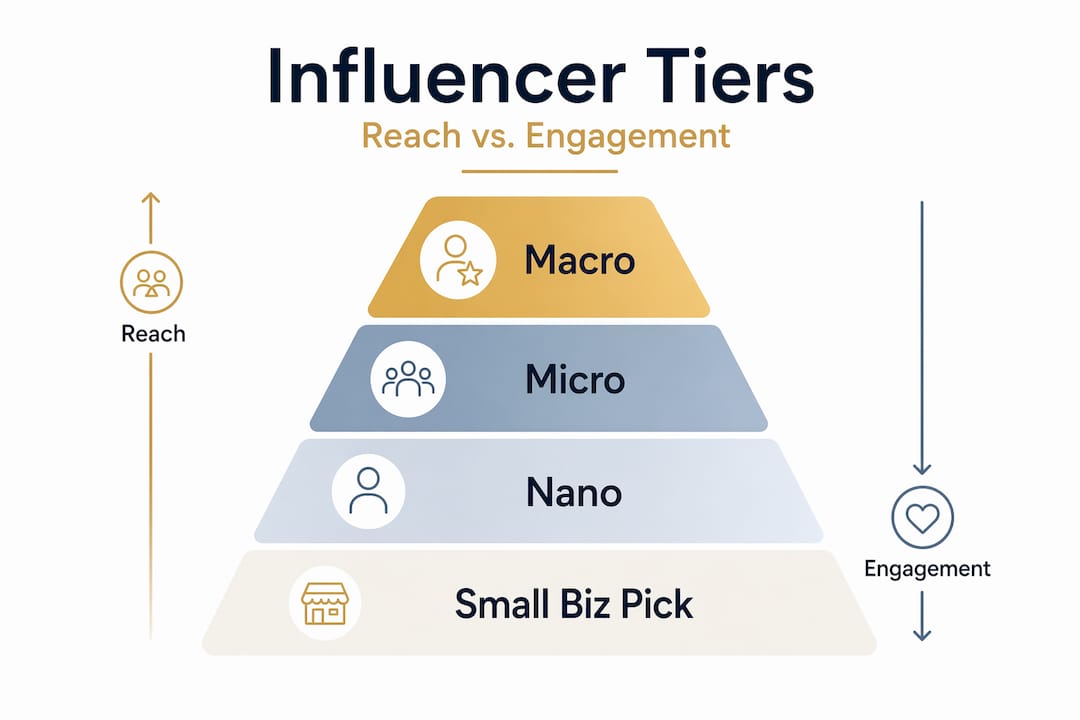
Nano and micro influencers deliver higher engagement and remain the most cost-effective starting point for small businesses. The numbers back this up. Micro influencers deliver 65% lower cost per engagement than macro influencers, making them far better suited for businesses focused on conversions rather than vanity reach.
Here is where most small business owners go wrong. They chase follower counts because the numbers feel impressive. A nano influencer with 4,000 deeply engaged followers in your local suburb or specific niche will almost always outperform a mid-tier influencer with 200,000 passive followers who barely interact. Audience fit matters more than follower count for small business success, full stop.
Matching influencer tier to your marketing funnel stage is how you get efficient. Nano influencers work well for building awareness at a local level and seeding products. Micro influencers are your conversion tier. Mid-tier and macro influencers are useful when you need mass visibility, but that is rarely the priority for a business operating under a $50,000 annual marketing budget. Matching influencer tiers to funnel stages optimises your return and stops you from blowing budget on reach that never converts.
Pro Tip: Before reaching out to any influencer, check their last 12 posts for comment quality. Genuine comments that reference the content itself signal real engagement. Generic “Great post!” comments in bulk almost always indicate bought or inactive followers.
How to find and engage influencers on a budget
Finding the right influencers does not require a $500 per month platform subscription. Start with what is already in front of you.
- Search niche hashtags on Instagram and TikTok. If you run a skincare clinic in Brisbane, search hashtags like #BrisbaneSkincare, #AustralianBeautyRoutine, or your specific treatment names. The people posting regularly with genuine engagement are your candidates.
- Look at who already follows and tags your brand. Your warmest prospects are existing customers who create content. They already believe in what you offer, which makes their endorsement far more credible.
- Check engagement rate before anything else. Divide average post likes and comments by total followers, then multiply by 100. A 4% rate on a 7,000-follower account beats a 0.8% rate on 90,000 followers for conversion purposes.
- Review content alignment, not just aesthetics. An influencer whose overall content matches your brand values will always outperform one who simply has a polished feed. Misalignment is immediately obvious to their audience.
- Start with gifting or affiliate arrangements. For nano influencers, product gifting with no cash fee is a reasonable starting point. For micro influencers, fair compensation matters. A combination of a fee, gifted product, and affiliate commission respects their work and aligns incentives.
- Scale relationships based on performance. Do not lock into long-term contracts upfront. Start with one or two posts, measure the results, then negotiate ongoing arrangements with the performers.
Your brief is the difference between content you can use and content that misses the mark entirely. A good brief covers your brand story, key messages, mandatory disclosures, content formats required, posting schedule, and approval steps. It should give the influencer enough direction to stay on-brand while leaving room for their natural voice. Clear guardrails with flexible storytelling increase authenticity and compliance versus overly scripted content that feels wooden and loses audience trust.
Pro Tip: Ask influencers to send you a draft or storyboard before filming. This saves everyone time and catches brand misalignment before production. A simple approval step in your brief prevents 90% of post-launch problems.
You can also explore influencer partnership examples for inspiration on how relationship-driven campaigns actually look in practice.
Compliance: what every small business must know
This section tends to get skipped. That is a mistake that can cost you real money and your reputation.
The FTC (Federal Trade Commission) and Australian Consumer Law both require influencers to clearly disclose when they have a material connection to a brand. That means any paid partnership, gifted product, or affiliate arrangement must be disclosed in a way that is obvious and upfront.
Key compliance requirements you need to build into every campaign:
- Caption placement matters. #ad or #sponsored must appear at the start of the caption, not buried after several lines of text where most people stop reading.
- Platform branded content tools are not enough. The “Paid Partnership” label Instagram and TikTok offer does not meet the FTC standard on its own. You still need explicit text disclosure.
- Video content requires verbal or on-screen disclosure. If the post is a video, a visible text tag or spoken mention at the beginning of the video is required, not just a caption tag.
- Brands carry the liability. Brands bear liability if influencers fail to disclose correctly. This means you cannot simply hand the responsibility to your influencer and hope for the best.
- Monitoring does not stop at posting. Your monitoring responsibility may extend beyond the contract period depending on whether the content remains live and visible.
Compliance is not the influencer’s problem to solve. It is yours. Build disclosure requirements into every brief, include them in your contract, and check every post before and after it goes live.
If any of your influencer content reaches European audiences, the EU’s Digital Services Act adds another layer of transparency requirements. Build these checks into your workflow from the start rather than retrofitting them after a complaint.
For a detailed look at Australian-specific compliance considerations, influencer marketing compliance is worth reviewing before you launch your first campaign.
Measuring results without a full analytics team
You do not need a dedicated data analyst to know whether your influencer marketing is working. You need three things: a tracking system, benchmarks, and the discipline to review them consistently.
- UTM parameters on every link. When an influencer mentions your website, the link they use should include a UTM code that identifies the traffic source in Google Analytics. This tells you exactly how many visitors came from that influencer, what pages they visited, and whether they converted.
- Unique promo codes per influencer. A code like SARAH15 or LOCALMUM20 tracks conversions directly at the point of sale. This works especially well for product-based and service-based businesses with booking systems.
- Engagement rate benchmarks. For nano influencers, a healthy benchmark sits around 5% to 11%. For micro influencers, 3% to 6% is solid. If an influencer is consistently below 1.5%, revisit the partnership.
One area that gets overlooked: content reuse across channels is where the real return on investment lives. A well-produced influencer video can become a Facebook ad, a landing page feature, an email campaign visual, and an Instagram reel. You paid for it once. Use it everywhere.
True campaign costs include product value, shipping, packaging, taxes, and the internal time your team spends briefing, reviewing, and monitoring. A nano influencer campaign that looks free because you gifted product instead of paying a fee can easily cost $200 to $400 once you account for everything. That is still excellent value compared to equivalent paid advertising reach, but you need the real number to evaluate performance honestly.

Pro Tip: Build a simple spreadsheet that tracks each influencer, their tier, the cost per post including all hidden costs, their average engagement rate, UTM-attributed traffic, and promo code conversions. Review it monthly. After three months you will know exactly which relationships are worth scaling.
Connecting influencer content to SEO, paid ads, and AI visibility
This is where small business influencer marketing stops being a standalone tactic and starts becoming a genuine growth system.
When an influencer publishes content that mentions your brand and links to your website, they generate a natural backlink. Large language models and AI search tools increasingly favour authentic brand mentions across trusted social and editorial sources. Getting your brand mentioned by multiple credible voices across Instagram, TikTok, YouTube, and blogs builds what AI systems read as social proof and authority. This is the intersection of influencer marketing and AI SEO, and it matters more in 2026 than it ever has before.
Here is how to connect influencer activity to your broader digital marketing:
- Use influencer-generated content as website UGC. Embed approved influencer posts or quote testimonials on your product or service pages. This adds fresh, authentic content that improves page relevance for SEO.
- Repurpose influencer videos as paid social ads. User-generated style content consistently outperforms polished brand creative in Meta and TikTok ad auctions. You get better results and lower cost per click.
- Feed top-performing influencer content into Google Ads. Responsive display ads using influencer imagery and quotes can dramatically improve click-through rates, particularly for service-based businesses.
- Include influencer quotes in email marketing. A testimonial from a trusted local influencer in your EDM subject line or opening paragraph builds immediate credibility.
This integration is exactly what Jarrodharman refers to as the Marketing Vortex: a connected system where each channel feeds and strengthens the others. Influencer marketing sits inside that system as a content and credibility engine, not as a separate exercise.
| Integration point | SEO benefit | Paid media benefit |
|---|---|---|
| Natural backlinks from influencer posts | Improved domain authority | N/A |
| Brand mentions across social channels | AI and GEO visibility signals | Social proof for ad creative |
| Repurposed content on website | Fresh UGC for on-page SEO | Lower cost per click in Meta ads |
| Influencer video ads | N/A | Higher conversion rate vs brand creative |
My honest take on what small businesses get wrong
I have worked with enough business owners across Australia to see the same mistakes repeat. The biggest one is not the compliance risk or the wrong influencer choice. It is the total absence of a system.
Most small businesses run one influencer campaign, get inconsistent results, and write the whole thing off. What they actually experienced was a single data point, not a strategy. Influencer marketing works as a repeatable system, not a one-off post. The businesses I see winning are running four to six micro influencer partnerships concurrently, testing different content styles, tracking what converts, and rotating in new creators every quarter based on data.
The second thing I see constantly: businesses under-invest in the brief and over-invest in the influencer fee. A $500 influencer posting off-brief content that does not align with your brand is money wasted. A $150 nano influencer with a thorough brief and proper disclosure instructions often delivers better results and content you can actually reuse.
And the hidden cost issue is real. I have watched businesses gift $800 worth of product, spend three hours on coordination, pay $30 in shipping, and then tell me the campaign cost nothing because they did not pay a creator fee. Know your real numbers. It changes every decision you make.
The good news: once you build the system once, it compounds. Your content library grows. Your SEO strengthens. Your paid ads get better creative. Your brand gets mentioned in AI-generated answers. This is not a side tactic. For a service-based business with a clear niche, a well-run influencer campaign can become one of your most reliable lead generation channels.
, Business Warriors | Digital Marketing Agency
Ready to build your influencer marketing system?
If you are serious about making influencer marketing work alongside your SEO, paid advertising, and social media strategy, having the right framework matters. Jarrodharman helps service-based businesses across Australia build connected marketing systems that generate consistent leads and sales, not sporadic results.

The Marketing Vortex method integrates influencer marketing with Google Ads, Meta advertising, SEO, and content strategy into a single, coherent growth engine. If you want your influencer content doing more work across every channel, explore Jarrodharman’s digital advertising media services or review the social media growth comparison to find the right starting point for your business. The goal is not more activity. It is more results from everything you are already doing.
FAQ
What is a nano influencer and why do they suit small businesses?
A nano influencer has between 1,000 and 10,000 followers and typically achieves engagement rates of up to 11.9% on TikTok. Their smaller, more focused audience makes them ideal for small businesses targeting specific local or niche communities.
How much does small business influencer marketing cost?
Costs vary significantly by tier, but nano influencer campaigns can begin with product gifting, while micro influencer posts typically range from a few hundred to a few thousand dollars. Always budget for hidden costs including product value, shipping, and internal coordination time.
Do small businesses need to include disclosure in influencer posts?
Yes. Brands bear legal responsibility for ensuring influencers disclose paid partnerships clearly. The disclosure must appear at the start of captions and include a verbal or on-screen mention in video content, as platform partnership labels alone do not meet FTC standards.
How do I measure whether my influencer campaign is working?
Track UTM-tagged traffic in Google Analytics, monitor unique promo code conversions, and compare engagement rates against tier benchmarks. Review these metrics monthly across all active influencer relationships.
How does influencer marketing help with SEO in 2026?
Natural backlinks from influencer posts improve domain authority, while authentic brand mentions across social channels signal credibility to AI and large language model search tools. Embedding approved influencer content on your website also adds fresh UGC that strengthens on-page SEO relevance.
Recommended
- Digital Marketing Ideas To Grow Your Business | Jarrod Harman
- 7 Influencer Marketing Examples to Grow Your Business Online – Jarrod Harman
- Social Influencer Marketing: Driving Growth for Australian Beauty Businesses – Jarrod Harman
- 7 Creative Social Media Marketing Ideas for Small Business – Jarrod Harman