17 July 2026
What is a marketing agency: your 2026 guide
Discover what is a marketing agency and how it helps businesses attract customers, boost their brand, and drive revenue in 2026.
TL;DR:
- A marketing agency provides a full team of specialists to develop strategies that attract customers and grow revenue. They manage multi-channel campaigns, analyze data, and identify opportunities across SEO, paid ads, social media, and content marketing. The best agencies build integrated systems that combine these channels to deliver measurable growth and clear accountability.
A marketing agency is a professional service provider that develops and implements marketing strategies to help businesses attract customers, build their brand, and grow revenue. Unlike a single freelancer or an internal hire, an agency brings a full team of specialists under one roof: strategists, media buyers, SEO experts, copywriters, designers, and data analysts. Most comprehensive agency retainers range between $3,000 and $15,000 per month, with live campaigns typically running within 30 days of onboarding. That speed and depth of expertise is the core reason business owners and marketing managers turn to agencies when they need results, not experiments.
What does a marketing agency do?
Marketing agencies combine strategy, design, data analysis, and multi-channel campaign management to deliver measurable growth for clients. That sentence covers a lot of ground, so it helps to break it into concrete functions.
At the campaign level, an agency plans where your budget goes, which channels carry your message, and what creative will convert browsers into buyers. They handle media buying across Google Ads, Meta advertising, and programmatic display. They write the copy, build the landing pages, and set up the tracking so you know exactly what is working.

At the strategic level, a good agency does something most internal teams struggle to do consistently: they look at your entire marketing picture and identify the gaps. That means auditing your SEO health, reviewing your email sequences, assessing your social media presence, and recommending where to concentrate effort for the highest return.
The core service categories a full-service agency typically covers include:
- SEO (technical, on-page, and off-page optimisation to rank in Google and increasingly in AI-generated answers)
- Google Ads and PPC (paid search campaigns targeting buyers with high purchase intent)
- Meta and social media advertising (Facebook, Instagram, and TikTok campaigns for awareness and lead generation)
- Content marketing (blog articles, video scripts, and social content designed to build authority and drive organic traffic)
- Email marketing (automated sequences and broadcast campaigns that nurture leads into clients)
- Web development and funnel building (conversion-focused websites and landing pages)
- Analytics and reporting (monthly performance reports that connect spend to revenue)
One distinction worth making: a marketing agency focuses on the full customer acquisition funnel, from awareness through to conversion. An advertising agency traditionally focuses on creative production and media placement. Many agencies today operate across both functions, which is why the terms are often used interchangeably.
Pro Tip: Ask any agency you consider to show you a sample monthly report. If it lists impressions and clicks but not leads and revenue, that agency is measuring activity, not results.
What are the main types of marketing agencies?
Agencies cover a diverse range of specialties, from SEO and paid media to branding and analytics, and they structure themselves in two broad models: full-service and specialist.
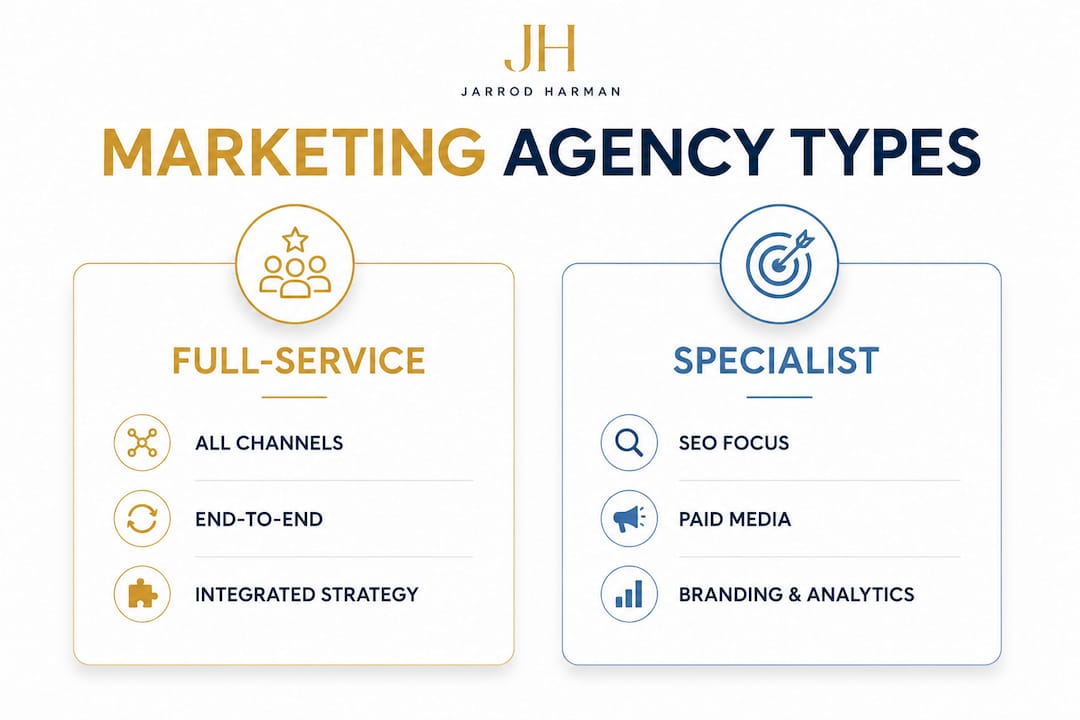
A full-service agency manages every marketing channel for a client. You get one point of contact, one integrated strategy, and one invoice. The trade-off is that no single agency is equally strong across every discipline. A specialist agency, by contrast, focuses on one channel or industry and goes deep. An SEO-only agency, for example, will typically have more technical depth than the SEO team inside a full-service shop.
| Agency type | Focus area | Best suited for |
|---|---|---|
| Full-service | All channels, end-to-end | Businesses wanting one partner for all marketing |
| SEO agency | Organic search, technical SEO, AI search visibility | Businesses prioritising long-term search growth |
| Paid media agency | Google Ads, Meta Ads, programmatic display | Businesses needing fast lead volume from paid channels |
| Social media agency | Content creation, community management, social ads | Brands building audience and engagement |
| Content and PR agency | Blog, video, media coverage, brand mentions | Businesses building authority and thought leadership |
| Industry-specialist agency | One vertical (e.g., beauty, legal, e-commerce) | Businesses wanting niche expertise and proven results |
Agency size also matters. A boutique agency with 5–15 staff often gives you direct access to senior talent on your account. A large global agency may assign junior staff to mid-tier clients. For most Australian service businesses, a mid-sized specialist agency with proven results in your industry delivers the best combination of expertise and attention.
Benefits of hiring a marketing agency vs in-house teams or AI tools
The cost comparison alone makes a compelling case. Annual agency costs sit between $36,000 and $180,000, while building an equivalent in-house team typically costs $180,000 to $300,000 or more when you account for salaries, superannuation, software licences, and training. That gap is significant for any business owner watching their margins.
Beyond cost, established agencies deliver faster speed to market because their workflows, tools, and team expertise already exist. An internal hire needs months to ramp up. An agency can have your Google Ads live and your SEO audit complete within weeks.
| Factor | Marketing agency | In-house team | AI tools only |
|---|---|---|---|
| Upfront cost | Low to medium | High (salaries, tools) | Low |
| Expertise breadth | High (multi-specialist) | Depends on hires | Limited to automation |
| Speed to market | Fast (30 days typical) | Slow (3–6 months ramp) | Fast but shallow |
| Strategic oversight | Yes | Varies | No |
| Accountability | Results-focused | Mixed responsibilities | None |
| Scalability | High | Limited by headcount | High but generic |
AI tools are genuinely useful for research, copy drafts, and reporting. The mistake is treating them as a replacement for strategic thinking. Top-growth brands use AI-assisted agency workflows to accelerate research, copy generation, and reporting, but a human strategist still decides where to spend the budget and why. AI does not challenge your assumptions. A good agency does.
Agency accountability is also structurally different from internal team accountability. An agency’s contract is tied to performance. If results do not come, you can adjust scope or exit. An internal hire’s accountability is diluted by HR processes, culture, and competing priorities.
Pro Tip: When comparing agency costs to in-house costs, include the full loaded cost of an employee: salary, super, leave entitlements, software, training, and management time. The real number is almost always higher than the headline salary.
How do you choose the right marketing agency?
Choosing the wrong agency costs you time, money, and momentum. A structured evaluation process cuts that risk significantly. Use this sequence when assessing your options.
-
Define your objectives first. Know whether you need more leads, better brand awareness, higher conversion rates, or all three. An agency cannot build the right strategy if you cannot articulate the goal.
-
Assess channel expertise. If SEO and organic search growth are your priority, look for an agency with documented ranking results and a clear process for AI search visibility and GEO (Generative Engine Optimisation). If paid ads are the focus, ask for Google Ads and Meta Ads case studies with real ROAS figures.
-
Check industry alignment. An agency that has worked in your sector understands your buyer’s psychology, your compliance requirements, and your seasonal patterns. That context shortens the learning curve and reduces wasted spend.
-
Evaluate onboarding and communication. Full operational alignment takes 30–90 days. Ask the agency to walk you through their onboarding process step by step. If they cannot describe it clearly, that is a red flag.
-
Set clear expectations on deliverables. Get specifics in writing: which channels, what reporting cadence, who your account manager is, and what success looks like at 90 days. Vague agreements produce vague results.
-
Watch for red flags. Agencies that promise page-one Google rankings in two weeks, guaranteed viral social content, or instant lead volume without a diagnostic phase are high-risk engagements. Legitimate agencies set realistic timelines and back them with process.
For a practical framework on launching marketing campaigns with an agency, the step-by-step guide at Jarrodharman covers the planning and execution sequence in detail. If you are also thinking about how AI-driven onboarding tools can support the process, BabyLoveGrowth’s white-label platform shows how agencies are using AI to accelerate client setup and reporting.
Key takeaways
A marketing agency delivers faster results, broader expertise, and clearer accountability than in-house teams or AI tools alone, making it the most cost-effective growth option for most service businesses.
| Point | Details |
|---|---|
| Definition | A marketing agency plans, executes, and optimises multi-channel strategies to grow your revenue. |
| Cost advantage | Agency retainers cost $36,000–$180,000 annually versus $180,000–$300,000+ for equivalent in-house teams. |
| Types matter | Match the agency type (full-service, SEO, paid media, specialist) to your specific growth objective. |
| AI is a tool, not a strategy | Agencies use AI to accelerate work, but human strategic oversight drives the decisions that matter. |
| Onboarding takes time | Expect 30–90 days for full alignment. Patience and clear communication in this period determine long-term results. |
The agency relationship most business owners get wrong
After working with hundreds of service businesses across Australia, the pattern I see most often is this: a business owner hires an agency expecting a vendor, and the agency delivers exactly that. The relationship stays transactional, reporting stays surface-level, and results plateau after the first few months.
The businesses that get the most from an agency treat it as a genuine partnership. They share their sales data, their customer feedback, and their internal goals. They push back when a strategy is not working. They show up to monthly reviews with questions, not just approval. That two-way accountability is what separates a good agency engagement from a great one.
The other misconception I encounter constantly is that AI tools have made agencies redundant. They have not. What AI has done is raise the floor: basic content, basic ads, and basic SEO are now table stakes. The value of a strong agency in 2026 sits above that floor, in the strategic decisions about where to focus, how to position your brand in AI-generated search results, and how to build a marketing system that compounds over time rather than just running campaigns month to month.
The agencies worth hiring in 2026 are the ones building omnichannel marketing systems that integrate SEO, paid advertising, social media, and email into a single, measurable engine. That is where the real growth happens.
, Business Warriors | Digital Marketing Agency
How Jarrodharman’s digital marketing services support your growth
Business owners who understand what a marketing agency does are already ahead. The next step is finding a partner who can execute across every channel that matters.
Jarrodharman’s digital marketing consulting and Business Warriors agency services cover SEO, Google Ads, Meta advertising, email marketing, and web development, all built around the Marketing Vortex method. This approach integrates every channel into one system so your marketing compounds rather than runs in silos. If you are a service business owner ready to move from scattered tactics to a structured growth system, the types of marketing strategies guide at Jarrodharman is the right place to start.
FAQ
What is a marketing agency in simple terms?
A marketing agency is a team of specialists hired to plan and run marketing activities for your business. They handle strategy, creative production, advertising, SEO, and reporting so you can focus on running your business.
How much does it cost to hire a marketing agency?
Most agency retainers range between $3,000 and $15,000 per month, which equates to $36,000–$180,000 annually. That is significantly less than the $180,000–$300,000+ cost of building an equivalent in-house team.
What is the difference between a marketing agency and a freelancer?
A marketing agency provides a full team with multiple specialisations, structured processes, and accountability systems. A freelancer offers one skill set and typically works across several clients without the same depth of resources or strategic oversight.
How long does it take to see results from a marketing agency?
Paid advertising campaigns can produce leads within the first 30 days. SEO and content marketing typically take 3–6 months to show significant organic growth. Full operational alignment between your business and the agency generally takes 30–90 days.
What should I look for when choosing a marketing agency?
Look for documented results in your industry, a clear onboarding process, transparent reporting tied to revenue rather than vanity metrics, and a team that asks as many questions as you do before proposing a strategy.