


TL;DR:
- Social media listening tools help service businesses gather real-time insights from online conversations beyond mere mentions. They enable proactive client engagement, reveal competitor weaknesses, and inform marketing strategies using genuine client language. Implementing these tools strategically provides a competitive edge, even for small businesses, by making smarter, data-driven decisions.
Most service business owners spend their online energy publishing content and responding to direct comments, believing that’s the full picture of social media engagement. It isn’t. The conversations shaping your reputation, revealing your competitors’ blind spots, and signalling what clients actually want are happening in places you’re probably not watching. Social media listening tools help you monitor, collect, and analyse those conversations across the internet, turning scattered online chatter into real business intelligence. This guide breaks down exactly how they work, compares the main options available, and shows you how to put them to use in your service business starting now.
Table of Contents
- What are social media listening tools?
- Benefits of using social media listening for service businesses
- Types of social media listening tools: Comparison and key features
- How to get started: A step-by-step approach for service businesses
- Why most business owners skip the hidden power of listening tools
- Take your client engagement further with expert-driven social media strategy
- Frequently asked questions
Key Takeaways
| Point | Details |
|---|---|
| Not just monitoring | Listening tools reveal valuable insights hidden beyond direct mentions or comments. |
| Boosts engagement | Proactive listening lets service businesses adapt fast, improving connections and sales. |
| Specialist vs suite tools | Choose a dedicated listening platform or a complete social management suite to fit your needs and resources. |
| Start with clear goals | Define what you want to achieve and monitor, then act on new insights regularly. |
What are social media listening tools?
Social media listening tools are software platforms designed to track what people say online about your brand, your industry, and the topics that matter to your clients. They go well beyond a simple notification that someone tagged you in a post. Think of them as an always-on intelligence system, scanning millions of conversations across social platforms, forums, review sites, blogs, and news sources.
Social listening tools analyse mentions, keywords, and topics across digital sources, converting them into insights your marketing team can actually use. That might mean spotting a spike in negative sentiment about a competitor’s service, identifying a new question your target clients are asking repeatedly, or catching a viral conversation relevant to your niche before your rivals do.
It’s worth separating a few terms that often get mixed up:
- Social media monitoring alerts you when someone mentions your brand or a keyword. It’s reactive and narrow.
- Social media listening analyses the broader context and patterns behind those mentions. It’s strategic and forward-looking.
- Publishing and engagement tools help you schedule content and respond to comments. They don’t analyse wider conversations at all.
“The difference between monitoring and listening is the difference between hearing noise and understanding what it means.”
For a service business owner in Australia, understanding what social listening actually is can reframe how you think about your entire online presence. Instead of guessing what clients want, you start seeing it in their own words. The benefits of social media management multiply significantly when you add listening to the mix, because every decision you make becomes grounded in real data rather than gut feeling.
Benefits of using social media listening for service businesses
Understanding the definition is one thing. Seeing how listening delivers a genuine competitive edge for Australian service businesses is where it gets interesting.
Identify shifting client preferences in real time. Markets move fast, especially in service industries like beauty, wellness, and professional services. Listening tools let you pick up on emerging language, new concerns, and trending topics before they become mainstream. A med spa owner in Perth, for example, might notice a surge in conversations around a new treatment type months before it becomes a client demand. That’s lead time you can use to position your offering ahead of the competition.
Uncover competitor weaknesses. When clients vent online about a competitor’s slow response times, inconsistent results, or poor follow-up, those complaints become your roadmap. Listening tools surface this feedback without you needing to spend hours manually scrolling through reviews and social posts. You find out exactly where the gap is and you fill it.

Respond to negative sentiment before it escalates. One unhappy client posting on a local Facebook group can attract dozens of sympathetic responses within hours. Listening tools help convert online data into actionable insights, including detecting changes in sentiment, so you can jump into a conversation early, address the issue, and demonstrate that your business actually cares. Handled well, a resolved complaint often builds more trust than five positive reviews.
Build better services using real client language. When you see the exact words your ideal clients use to describe their problems, you can mirror that language in your marketing. This isn’t manipulation. It’s genuine alignment. Your Google Ads copy, your email subject lines, and your website headlines all become sharper because they reflect how clients already think.
Shape campaigns with trend data before launch. This is where listening becomes genuinely powerful for your return on investment. Instead of launching a campaign based on assumptions, you launch it based on what’s already resonating.
Pro Tip: Pull a monthly report from your listening tool and use the trending topics and phrases to brief your content creator or copywriter. This one habit can dramatically increase the relevance of everything you publish.
Understanding the role social media plays in digital marketing becomes much clearer once you see how listening tools amplify every other channel you’re using. They also play a direct part in social media listening for client acquisition, helping you identify prospects who are already expressing buying intent. The advantages of social media for business extend well beyond follower counts when you use listening strategically.
Types of social media listening tools: Comparison and key features
To select the best tool, it’s important to understand the available options and how their features stack up for different business needs.
Some tools focus on listening only, while others are part of broader suites that integrate publishing, scheduling, and workflow management. Neither approach is universally better. The right choice depends entirely on what your business actually needs right now.
Listening-only tools specialise in monitoring, deep analytics, and alerts. They tend to offer more granular sentiment analysis, more extensive source coverage, and more sophisticated reporting. Mention is a well-known example in this category. These tools are excellent if your primary need is intelligence gathering and you already have separate tools for publishing and community management.
Full-suite platforms combine listening features with content scheduling, team collaboration, analytics dashboards, and sometimes customer relationship management integrations. These are often better suited to small teams who want everything in one place.
Here’s a practical comparison to help you think through the decision:
| Feature | Listening-only tools | Full-suite platforms |
|---|---|---|
| Sentiment analysis depth | Advanced | Basic to moderate |
| Source coverage | Broad (forums, blogs, news) | Primarily social platforms |
| Publishing and scheduling | Not included | Included |
| Ease of use | Moderate | Generally simpler |
| Cost | Moderate to high | Varies widely |
| Reporting and export | Detailed and customisable | Standard dashboards |
| Team size suitability | Solo to medium teams | Solo to large teams |
| Integration with other tools | Often available | Usually built-in |
Key questions to ask before choosing a tool:
- How large is your team? A sole operator doesn’t need enterprise-grade collaboration features.
- What platforms do your clients use most? Make sure the tool covers them thoroughly.
- What’s your primary goal? If you mainly want to track brand sentiment, a listening-only tool may serve you better. If you want one platform for everything, a full suite makes more sense.
- What’s your monthly budget? Costs range from around $30 per month for basic plans up to several hundred dollars for advanced features.
For a more thorough look at how different platforms compare, the social media management tools comparison for 2025 breaks down the landscape in detail. If you’re new to this space, starting with social media marketing for beginners gives you the foundational context to make better decisions about which tools suit your stage of growth.
How to get started: A step-by-step approach for service businesses
Once you’ve chosen the tool that fits, here’s how to put social media listening into practice for real results.
Step 1: Define your listening objectives clearly. Before you set up a single alert, get specific about what you want to learn. Are you trying to understand how clients feel about your business right now? Do you want to find out what questions people are asking before they book a service like yours? Are you looking to track what’s being said about a specific competitor? Your objectives shape everything that follows.
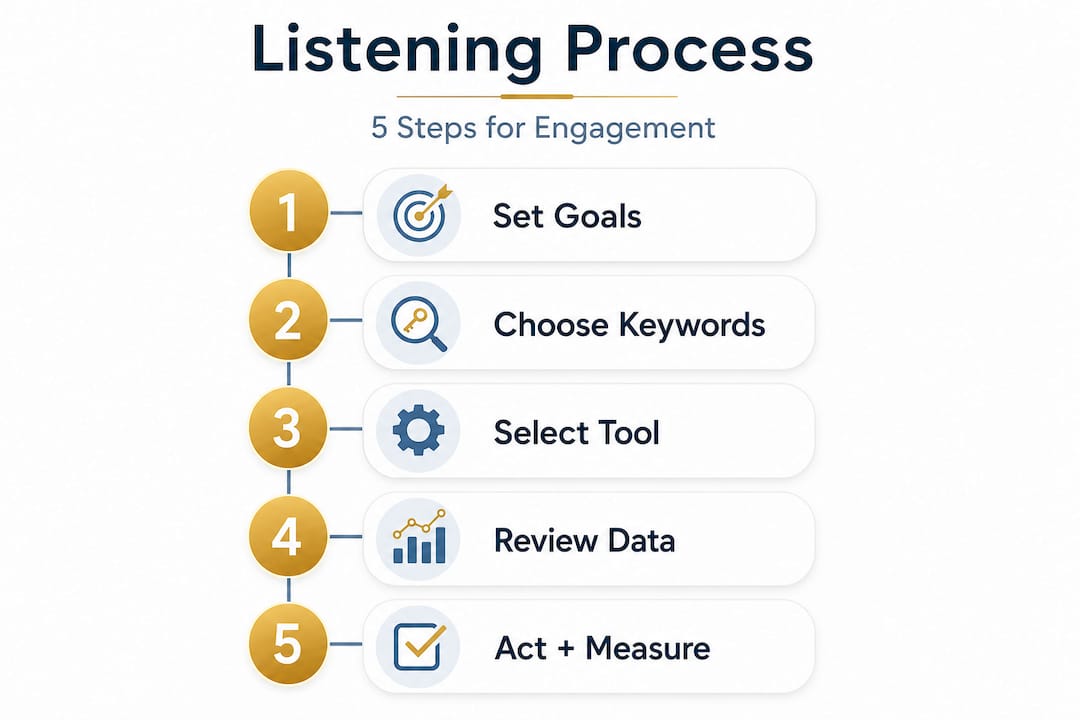
Step 2: Build your keyword and topic list. This step takes more thought than people expect. Start with your brand name and variations of it (including common misspellings). Add your core services, your location, and relevant industry terms. Include competitor names if your tool supports it. Also add the problem language your ideal clients use, not technical service terms, but the way someone describes their frustration before they’ve found a solution.
Step 3: Select your tool and configure alerts. Set up real-time or daily alerts for your highest-priority keywords, particularly around your brand name and any negative sentiment triggers. Configure your reporting so you receive a weekly summary you can actually review in under 20 minutes. Social media listening enables tracking of keywords, topics, and competitor conversations to uncover emerging opportunities, so make sure your setup captures all three dimensions.
Step 4: Create a regular review rhythm. Data sitting in a dashboard does nothing. Block time in your weekly schedule to review what the tool is surfacing. Look for patterns, not just individual mentions. Is there a recurring complaint? A topic gaining momentum? A positive theme you could amplify in your marketing?
Step 5: Act on what you find and measure the impact. Listening without action is just surveillance. When you spot an insight, document it, assign it to the right person, and track what happens when you respond. Did addressing that negative comment thread lead to the client returning? Did using a trending phrase in your next campaign increase click-throughs? Measurement closes the loop and builds the business case for ongoing investment.
Pro Tip: Assign one team member ownership of the weekly listening review. When accountability is clear, insights actually get turned into decisions rather than sitting unread in an inbox.
Use a social media checklist with proven steps to build listening reviews into your existing workflow rather than treating them as a separate project. Pairing listening with your broader social media growth strategies creates a feedback loop where every campaign learns from the last.
Why most business owners skip the hidden power of listening tools
After laying out the practical steps, it’s worth asking an honest question: if this is so valuable, why do so many service business owners ignore it?
The answer is almost always the same. Publishing feels productive. Scheduling three posts for the week, boosting a promotion, replying to a few comments, it all feels like visible progress. Listening, by contrast, feels passive. It doesn’t produce anything you can immediately point to. So it keeps getting pushed down the priority list until it disappears entirely.
This is a costly mistake. The businesses we work with that gain the sharpest competitive edge aren’t the ones posting the most. They’re the ones who understand their market at a deeper level than their competitors do. They know when client sentiment is shifting. They catch problems before they become crises. They find new angles for campaigns because they’re genuinely paying attention to what clients say when no one’s directly asking them.
There’s also a misconception that listening tools are only relevant for large brands with dedicated social media teams. In reality, even a single-location clinic or a boutique legal firm can extract enormous value from 30 minutes of weekly listening review. The scale of your business doesn’t determine the value of the insight. What determines the value is whether you act on what you learn.
The businesses that weave client acquisition through listening into their regular marketing rhythm consistently stay ahead of those who only broadcast. Listening is not a nice-to-have. It’s a core intelligence function that makes every other part of your marketing smarter.
Take your client engagement further with expert-driven social media strategy
Knowing the strategy and executing it consistently are two very different things. Service business owners who want to accelerate their results don’t have to figure it out in isolation.

At Business Warriors, we help service-based businesses across Australia build and run social media systems that do more than look active online. Our social media growth service comparison gives you a clear picture of what’s available and what fits your current stage. For businesses ready to integrate listening, content, advertising, and client acquisition into one cohesive approach, our Marketing Vortex method is the framework we’ve built specifically for service businesses that want measurable growth. Reach out to explore how a tailored strategy session can turn your online presence into your strongest sales channel.
Frequently asked questions
How do social media listening tools work?
They track and analyse mentions across platforms, converting keywords, topics, and brand references from social and digital sources into actionable business insights you can use to make smarter marketing decisions.
What’s the difference between listening and monitoring?
Monitoring finds and alerts you to mentions; listening goes further by analysing broad conversations and trends across multiple sources, giving you the strategic context needed to guide decisions rather than just react to individual mentions.
Which platforms should I listen to for my business?
Focus on platforms where your clients are most active, typically Facebook, Instagram, LinkedIn, and relevant forums or review sites like Google Reviews and industry-specific communities popular in Australia.
Can listening tools help with negative feedback?
Yes, they allow you to spot and address negative sentiment quickly, often before it affects your reputation. Detecting changes in sentiment early gives you the window to respond thoughtfully and turn a dissatisfied client into a loyal one.
How do I measure return on investment from social listening?
Track metrics like increased client engagement rates, a reduction in unresolved complaints, and improvements in campaign performance tied to insights from listening data, including more enquiries or direct bookings resulting from better-targeted messaging.