


TL;DR:
- A marketing guru is a recognized expert who builds authority through consistent content, measurable results, and a multi-channel system. They use SEO, paid ads, and AI tools to drive sales, ensuring their strategies lead to tangible business outcomes. Genuine expertise is demonstrated by long-term publishing, original research, and peer recognition based on proven revenue growth.
A marketing guru is a recognised expert whose proven strategies and thought leadership help businesses expand their online presence and increase sales. The term overlaps directly with what Joel Kurtzman coined in 1994 as “thought leadership,” describing influential experts who publish consistent, authoritative content that drives measurable business outcomes. For ambitious entrepreneurs aged 30 to 50, understanding what separates a genuine digital marketing expert from a self-proclaimed one is the difference between wasting budget and building a sales machine. The methods these experts use, including SEO, Google Ads, Meta advertising, AI-driven content, and social media, are not secrets. They are systems. This article breaks down exactly how they work and how you can apply them.
What does a marketing guru actually do?
A marketing guru builds authority through a combination of original content, measurable strategy, and consistent public presence across multiple channels. They do not simply post motivational quotes on LinkedIn. They publish original research, run paid campaigns, track pipeline metrics, and update their thinking when the data changes.
The role intersects with several specialisations. A content marketing specialist focuses on articles, podcasts, videos, and social posts, using SEO and keyword research as core skills. A branding strategist shapes how a business is perceived across every touchpoint. An online marketing consultant diagnoses gaps and builds channel strategies. A true marketing guru synthesises all of these disciplines into one coherent system.
Platforms like LinkedIn, YouTube, and email newsletters are the primary distribution channels for B2B-focused gurus. For consumer-facing businesses, Instagram, TikTok, and Google Search dominate. The gurus who generate real revenue use all of them in an integrated way, not in isolation.
How marketing gurus build authority through SEO and content
The foundation of any marketing guru’s authority is content that ranks, gets shared, and converts. SEO strategy sits at the centre of this. Keyword research, on-page optimisation, internal linking, and technical SEO are not optional extras. They are the infrastructure that makes everything else visible.

AI SEO and generative engine optimisation (GEO) are now critical additions to this toolkit. Getting your brand mentioned inside large language models like ChatGPT, Perplexity, and Google’s AI Overviews requires a different approach than traditional SEO. You need authoritative backlinks, consistent brand mentions across trusted publications, structured data, and content that directly answers specific questions. The gurus who understand this are already building for AI citation, not just Google rankings.
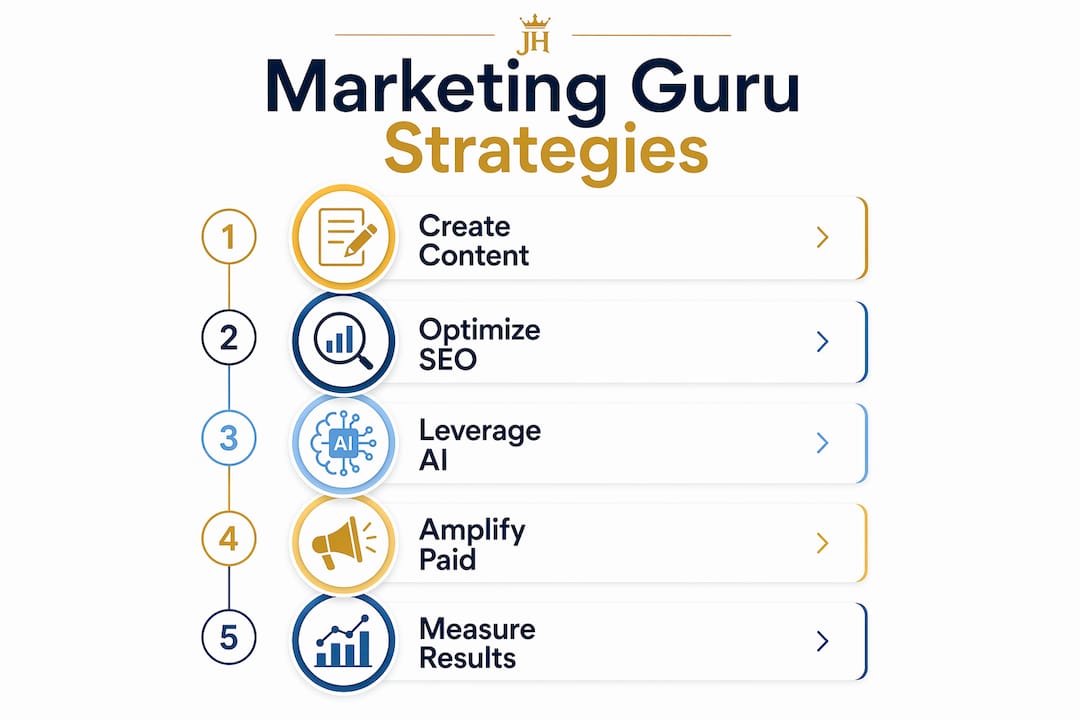
Pro Tip: Publish one long-form article per week targeting a specific question your audience types into Google. After 90 days, promote the top three performers with paid traffic to compress the feedback loop.
Paid advertising amplifies organic content that already shows signs of engagement. Modern marketing gurus validate organic social presence with paid media spend to maximise relevance and ROI. Running Google Ads or Meta campaigns to content that already converts organically is far more efficient than cold prospecting with paid ads alone. Tools like Google Analytics 4, SEMrush, Ahrefs, and Meta Ads Manager give practitioners the data they need to make these decisions with precision.
Social media marketing for gurus is not about posting volume. It is about publishing content that earns attention, then retargeting that audience with offers. Instagram Reels, YouTube Shorts, and LinkedIn articles each serve a different stage of the buyer journey. The best practitioners map content formats to funnel stages and measure each one separately.
How to spot a real marketing expert vs. a fake one
The biggest misconception about marketing gurus is that the title is self-assigned. Credible guru recognition comes from peers and customers based on proven, measurable expertise, not follower counts or speaking gig frequency.
Here are the markers that separate genuine expertise from performance:
- Consistent long-term publishing. Real experts have years of content on record, not a burst of activity before a product launch.
- Original research or frameworks. They introduce ideas, not just curate them. Think Gary Vaynerchuk’s “jab, jab, jab, right hook” or the Business Warriors Marketing Vortex method.
- Measurable business outcomes. They can point to client results, case studies, and revenue impact, not just impressions and reach.
- Willingness to be publicly wrong. Earning the guru label requires updating ideas when evidence changes, which most self-promoters refuse to do.
- Peer recognition. Other credible practitioners reference their work, not just their followers.
Vanity metrics are the most common trap. Views, likes, and follower growth tell you about visibility, not revenue.
“Distinguish between content focused on visibility and content proven to convert with measurable sales outcomes. Ground creative work in data that directly ties to revenue, not vanity metrics.” — Gary Vaynerchuk
A social media guru with 200,000 followers who cannot show you a client’s revenue growth is not a marketing expert. They are an entertainer. The distinction matters enormously when you are deciding who to learn from or hire.
Marketing guru vs. content specialist vs. branding strategist
Understanding the differences between marketing roles helps you decide which expertise to build internally, outsource, or emulate. The table below maps the key distinctions:
| Role | Primary focus | Core tools | Best for |
|---|---|---|---|
| Marketing guru | Full-system authority and thought leadership | SEO, paid ads, content, analytics, AI tools | Entrepreneurs building personal brand and business growth |
| Content marketing specialist | Content creation, SEO, audience growth | CMS platforms, Ahrefs, SEMrush, Canva | Businesses scaling organic traffic and brand awareness |
| Branding strategist | Brand identity, positioning, perception | Brand audits, design systems, messaging frameworks | Businesses repositioning or entering new markets |
| Online marketing consultant | Channel strategy, campaign management, ROI | Google Ads, Meta Ads, CRM, analytics dashboards | Businesses needing tactical execution and measurable ROI |
| Influencer marketing strategist | Creator partnerships, audience reach, social proof | Creator platforms, affiliate tracking, social analytics | Consumer brands seeking rapid audience expansion |
Each role serves a different purpose. At the early stage of business growth, an online marketing consultant who can run Google Ads and Meta campaigns delivers the fastest return. As the business matures, a content marketing specialist builds the organic asset base. A branding strategist becomes critical when you are competing on perception rather than price. The marketing guru role is what you become when you master all of these disciplines and teach others to do the same.
How to apply marketing guru strategies to scale your business
Applying expert-level marketing to your own business does not require a 70-person team. It requires a system. A sophisticated approach treats strategy as a measurable system across diverse channels, not just individual tactics.
Follow this framework to build yours:
- Audit your current channels. Identify which platforms are generating leads and which are consuming budget without results. Use Google Analytics 4 and your CRM to map the data.
- Build an omnichannel content calendar. Publish weekly long-form SEO content, daily or near-daily social posts, and a monthly email newsletter. Each format serves a different stage of the buyer journey.
- Set up a measurement plan. Connect marketing activity directly to sales pipeline metrics including lead qualification rates, win rates, and sales cycle length. This prevents mistaking engagement for revenue.
- Optimise your landing pages. Well-optimised pages convert 10 to 20 percent of visitors, and systematic optimisation can reduce cost per lead by 30 to 50 percent without compromising quality. Start with your highest-traffic pages and test one element at a time.
- Run paid advertising to amplify what works. Once organic content proves it converts, put Google Ads or Meta budget behind it. This is how you scale without guessing.
- Build community. Facebook Groups, LinkedIn communities, and email lists are owned audiences that no algorithm change can take away from you. Invest in community-led growth from the beginning.
Pro Tip: Do not evaluate SEO or content channels before 90 days. SEO and content require at least 90 to 180 days to demonstrate revenue impact. Track leading indicators like pipeline meetings and qualified leads first, then assess revenue contribution.
The most common mistake entrepreneurs make is abandoning channels too early. A Google Ads campaign needs at least four to six weeks of data before optimisation decisions are meaningful. An SEO programme needs a full quarter. Patience combined with disciplined measurement is what separates businesses that scale from those that spin their wheels.
Tracking the right marketing metrics from day one keeps you focused on revenue rather than reach. Cost per lead, lead-to-sale conversion rate, and customer acquisition cost are the numbers that matter. Impressions and reach are secondary.
Key takeaways
A marketing guru earns authority through consistent content, measurable results, and a multi-channel system that connects marketing activity directly to sales outcomes.
| Point | Details |
|---|---|
| Guru status is earned, not claimed | Peer and customer recognition based on proven results defines a real marketing expert. |
| SEO and AI visibility are non-negotiable | Ranking on Google and getting cited in AI tools like ChatGPT requires structured, authoritative content. |
| Measurement plans prevent wasted budget | Linking every marketing activity to pipeline metrics stops you from mistaking engagement for revenue. |
| Paid and organic work together | Validate organic content first, then amplify with Google Ads or Meta to compress results. |
| Channel patience drives results | SEO and content need 90 to 180 days before fair revenue assessment. Track leading indicators first. |
What I have learned from building marketing systems that actually work
After years of working with service businesses across Australia, the pattern is consistent. The entrepreneurs who get results are not the ones chasing the newest platform or the most viral content. They are the ones who build a system, measure it honestly, and stay patient long enough for it to compound.
The rise of AI SEO and generative engine optimisation has changed the game significantly. Getting your brand mentioned inside ChatGPT or Perplexity is now as important as ranking on page one of Google. The businesses that invest in authoritative content, earn quality backlinks, and maintain consistent brand signals across the web are the ones appearing in AI-generated answers. That is where the next wave of organic traffic is coming from, and most businesses in Australia are not positioned for it yet.
The other thing I see consistently is the paid versus organic debate. Neither wins alone. Paid advertising without organic credibility burns budget. Organic content without paid amplification grows too slowly for most businesses to sustain. The gurus who get this right use paid spend to test messaging quickly, then build organic content around what converts. It is a feedback loop, not a competition.
Measurement is where most businesses fail. They look at follower counts and website traffic and feel good about their marketing. Then they wonder why revenue is flat. Tying every campaign back to qualified leads, sales conversations, and closed revenue is the discipline that separates businesses that grow from those that stay busy without results.
— Business Warriors | Digital Marketing Agency
Ready to build your own marketing system?
If this article has shown you the gap between where your marketing is now and where it needs to be, the next step is building a system that closes it. At Jarrodharman, the Marketing Vortex method is a 360-degree strategy built specifically for service businesses that combines SEO, Google Ads, Meta advertising, email marketing, and social media into one integrated engine.
Whether you are starting from scratch or scaling an existing presence, the framework is designed to generate consistent leads and reduce your reliance on any single channel. You can also explore how to create a marketing vortex for step-by-step guidance on building a dependable lead generation system. If you are serious about growth, this is where to start.
FAQ
What is a marketing guru?
A marketing guru is a recognised expert in marketing strategy whose consistent content, measurable results, and peer recognition set them apart from self-proclaimed titles. The concept overlaps with thought leadership, a term coined in 1994 by Joel Kurtzman.
How do I become a digital marketing expert?
Build authority by publishing original content consistently, mastering SEO and paid advertising, and tying every campaign to measurable sales outcomes. Recognition follows results, not self-promotion.
What is the difference between a marketing guru and a content marketing specialist?
A content marketing specialist focuses on creating and distributing content formats like articles, videos, and podcasts using SEO and keyword research. A marketing guru operates across all channels and disciplines, combining content, paid advertising, branding, and analytics into a single growth system.
How long does SEO take to show results?
SEO and content channels require 90 to 180 days before revenue impact can be fairly assessed. Track leading indicators like qualified leads and pipeline meetings during this period rather than judging the channel on revenue alone.
What marketing metrics should I track as a business owner?
Track cost per lead, lead-to-sale conversion rate, customer acquisition cost, and sales cycle length. These connect marketing activity directly to revenue and prevent you from optimising for vanity metrics like impressions or follower growth.