


TL;DR:
- Social media advertising involves paying platforms to target specific audiences with your content. It is a cost-effective way for Australian businesses to generate bookings when campaigns are properly set up, tested, and refreshed regularly.
Social media advertising is the practice of paying platforms like Meta (Facebook and Instagram), TikTok, and LinkedIn to show your content to a precisely defined audience. Over 5.17 billion people used social media in 2025, and that number is projected to exceed 6 billion by 2028. That reach makes paid social one of the most cost-effective channels available to Australian business owners today. Knowing how to run social media ads correctly, from platform selection through to budget scaling, is what separates campaigns that generate real bookings from ones that quietly drain your account.
Which social media platforms suit your business goals?
Platform choice is the single most consequential decision you make before spending a dollar. Each platform attracts a different audience and rewards different content styles, so matching your business type to the right channel saves both money and time.
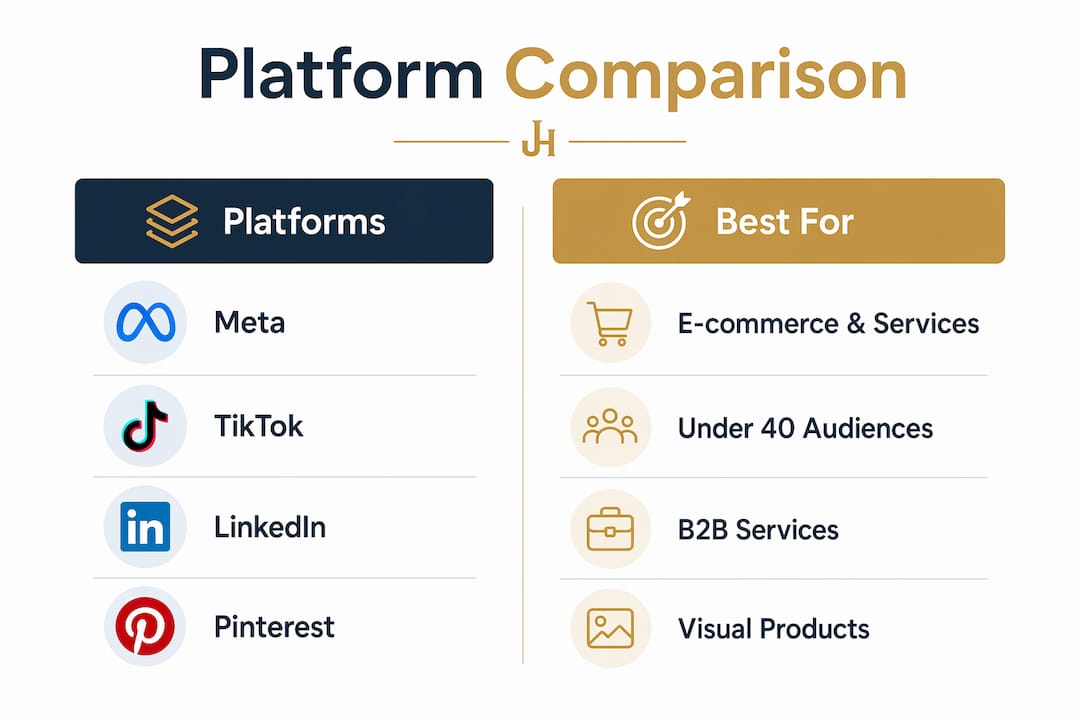
Meta (Facebook and Instagram) remains the dominant choice for service-based businesses, e-commerce brands, and local operators. Its targeting depth, including interests, life events, and lookalike audiences built from your customer list, is unmatched for reaching buyers in a defined geographic area. Australian salons, clinics, and retail businesses consistently generate bookings through Meta’s lead generation and conversion campaigns.
TikTok suits brands targeting audiences under 40 who respond to authentic, fast-paced content. Its algorithm surfaces content to non-followers aggressively, which means a well-produced short video can reach cold audiences at a lower cost per thousand impressions than older platforms.
LinkedIn is the right choice for B2B service providers, consultants, and professional services firms. Its audience targeting by job title, industry, and company size makes it the most direct route to decision-makers, though cost per click runs higher than Meta or TikTok.
Pinterest works well for visual product categories including homewares, fashion, and beauty. Its users actively search for ideas and products, which means purchase intent is higher than on most other platforms.
| Platform | Best for | Targeting strength | Typical budget entry point |
|---|---|---|---|
| Meta (Facebook/Instagram) | Local services, e-commerce, lead generation | Interests, lookalikes, life events | $20–$50 per day |
| TikTok | Brand awareness, younger demographics | Behavioural, interest-based | $20–$50 per day |
| B2B leads, professional services | Job title, industry, company size | $50–$100 per day | |
| Visual products, lifestyle brands | Search intent, interest categories | $10–$30 per day |
Avoid spreading small budgets across multiple platforms at once. Concentrate on one or two channels until you have enough conversion data to make informed decisions, then expand.
What do you need to set up before running ads?
Tracking infrastructure comes before creative. Without it, you are flying blind on which ads generate revenue and which ones simply generate clicks.
- Create a Business Manager account on Meta or the equivalent Ads Manager on your chosen platform. This separates personal profiles from paid campaigns and allows multiple team members to access the account securely.
- Install your tracking pixel and conversion API. The Meta Pixel and TikTok Pixel both take roughly 15 minutes to install but are critical for measuring every conversion and feeding data back to the platform’s algorithm.
- Connect Google Analytics 4. GA4 gives you a platform-agnostic view of traffic and conversions, which is especially useful when running ads across multiple channels simultaneously.
- Add UTM parameters to every ad URL. UTM tags tell GA4 exactly which campaign, ad set, and creative drove each visit. Without them, paid traffic blends into your organic data and attribution becomes guesswork.
- Set up server-side tracking where possible. Browser-based pixels lose data due to ad blockers and iOS privacy changes. Server-side tracking via a conversion API sends event data directly from your server to the platform, improving attribution accuracy significantly.
Pro Tip: If you manage ads across multiple client accounts or business entities, use a dedicated browser profile or a business-grade account management tool for each. Mixing accounts in a single browser session increases the risk of policy flags and account restrictions.
How do you create ads that actually convert?
The creative is what stops the scroll. A technically perfect campaign with weak creative will underperform every time. Platform-native creative consistently outperforms content that has been copied across channels without adaptation.

Short-form vertical video in the 9:16 ratio, running between 15 and 30 seconds, delivers the lowest cost per thousand impressions and the highest engagement across Facebook, Instagram, and TikTok. The first two seconds must hook the viewer with a bold claim, a surprising visual, or a direct question. Everything after that supports the hook and leads to a clear call to action.
Tone and style must match the platform. TikTok rewards raw, conversational delivery that feels like a genuine recommendation from a real person. LinkedIn expects a more polished, professional presentation. Posting the same video to both platforms without adjusting the pacing, captions, or opening line is one of the most common and costly mistakes business owners make.
Ad format options worth testing include:
- Single image ads: Fast to produce, effective for direct response offers with a strong headline and clear CTA.
- Carousel ads: Ideal for showcasing multiple products, service packages, or before-and-after results.
- Short-form video ads: Highest engagement format across Meta and TikTok; prioritise authentic delivery over high production value.
- Lead generation ads: Built-in forms that capture name, email, and phone number without the user leaving the platform. Effective for service businesses booking consultations.
- Story and Reel ads: Full-screen vertical placements with high visibility; best used with punchy, time-sensitive offers.
Testing 5 to 10 creative variations per platform, each with a different hook or CTA, gives the algorithm enough data to identify what resonates with your audience. Systematic testing is what separates businesses that scale from those that plateau.
Pro Tip: Refresh your ad creative every 2–3 weeks. Ad fatigue sets in when the same audience sees identical creative repeatedly, and frequency metrics above 3–4 for cold audiences signal it is time to rotate.
How do you plan budgets and scale winning campaigns?
Budget discipline is what keeps campaigns profitable as you grow. The goal in the early phase is not to generate maximum revenue. It is to gather enough data to know which creative, audience, and offer combination works.
A daily testing budget of $20 to $50 per ad set gives the platform’s algorithm enough spend to exit the learning phase and start optimising delivery. Running below this threshold extends the learning phase and produces unreliable data. Once an ad set demonstrates a cost per acquisition you can sustain, increase the budget gradually, no more than 20% every few days, to avoid resetting the algorithm’s learning.
The three metrics that matter most for scaling decisions are:
- Click-through rate (CTR): A low CTR signals weak creative or poor audience match. Fix the creative before increasing spend.
- Cost per acquisition (CPA): The total ad spend divided by the number of conversions. This tells you whether the campaign is profitable at its current scale.
- Return on ad spend (ROAS): Revenue generated divided by ad spend. A ROAS above 3.0 is generally considered healthy for product-based businesses, though service businesses often measure by cost per booked appointment instead.
| Stage | Daily budget per ad set | Key action |
|---|---|---|
| Testing | $20–$50 | Run 5–10 creative variations; identify top performers |
| Optimising | $50–$150 | Pause underperformers; increase budget on winners by 20% |
| Scaling | $150+ | Expand audiences with lookalikes; introduce new creative |
Monitor key metrics for a full week before making any budget or creative changes. Daily fluctuations are normal and reacting to them prematurely wastes both money and data.
What mistakes do most business owners make with social media ads?
The most expensive mistake is launching campaigns without tracking in place. Without platform pixels and conversion APIs, the algorithm cannot learn which users convert, which means it optimises for clicks rather than customers. Install tracking before you spend a single dollar.
The second most common error is splitting a small budget across too many platforms simultaneously. A $30 daily budget spread across Meta, TikTok, and LinkedIn gives each platform $10 per day. That is not enough for any platform to exit its learning phase, and you end up with three sets of inconclusive data instead of one clear winner.
Common mistakes and their fixes:
- Skipping the tracking setup: Install Meta Pixel, TikTok Pixel, and GA4 before creating your first campaign.
- Copying creative across platforms: Adapt tone, format, and pacing for each platform’s audience expectations.
- Reacting to daily data swings: Wait at least seven days before drawing conclusions from performance data.
- Ignoring ad frequency: Pause ads when frequency exceeds 3–4 for cold audiences and rotate fresh creative.
- Scaling too fast: Increase budgets by no more than 20% at a time to preserve algorithm stability.
“The businesses that win with paid social are not the ones with the biggest budgets. They are the ones that test methodically, track everything, and refresh their creative before their audience gets bored.”
Key takeaways
Successful social media advertising requires tracking infrastructure, platform-native creative, disciplined budget testing, and consistent creative renewal to generate measurable returns.
| Point | Details |
|---|---|
| Install tracking first | Set up Meta Pixel, TikTok Pixel, and GA4 before spending any budget. |
| Choose one or two platforms | Focus your budget on the channels that match your audience before expanding. |
| Test multiple creative variations | Run 5–10 variations per platform to identify the hooks and CTAs that convert. |
| Scale budgets gradually | Increase ad set budgets by no more than 20% every few days to maintain algorithm stability. |
| Refresh creative regularly | Rotate ad creative every 2–3 weeks to prevent audience fatigue and maintain engagement. |
What I have learned running paid social campaigns for Australian businesses
The advice that circulates online about social media ads tends to focus on tactics. What it underestimates is the role of patience and integration. Business owners who treat paid social as a standalone channel, disconnected from their SEO, email marketing, and Google Ads, consistently get weaker results than those who run it as part of a coordinated system.
AI-powered targeting has changed the game significantly. Platforms now use behavioural signals to identify users who are close to a purchase decision, which means AI targeting ties conversions to your spend far more precisely than manual audience selection ever could. The implication is that your job as an advertiser is to give the algorithm quality creative and a clear conversion signal, then let it work. Micromanaging audience settings often interferes with this process.
The other thing I see consistently underestimated is the connection between social media ads and brand visibility in AI-driven search. When your brand appears in paid social, generates engagement, earns mentions, and drives traffic to well-structured content, it builds the kind of digital footprint that large language models and AI search tools like Perplexity and Google’s AI Overviews draw from. Paid social is not just a lead generation tool. It is a brand signal that feeds into your broader SEO and GEO (generative engine optimisation) presence.
For businesses serious about growth, the social media advertising advantages extend well beyond the immediate campaign window. Every dollar spent on a well-run campaign builds audience data, creative learnings, and brand recognition that compounds over time. That is the part most short-term thinkers miss.
— Business Warriors | Digital Marketing Agency
How Jarrodharman helps businesses run better paid social campaigns
Running profitable social media ads takes more than a boosted post and a decent image. It requires a structured system that connects your creative, your tracking, your offer, and your audience into a single, measurable machine.
Jarrodharman and the Business Warriors team work with Australian service businesses, e-commerce brands, and enterprises to build exactly that. From Meta and TikTok ad management through to full digital marketing strategy, the focus is always on measurable outcomes: bookings, leads, and revenue. If you are ready to move beyond guesswork and build a paid social system that scales, explore Jarrodharman’s client acquisition strategies and see what a structured approach looks like in practice.
FAQ
What are social media ads?
Social media ads are paid promotions that appear on platforms like Meta, TikTok, and LinkedIn, targeting specific audiences based on demographics, interests, and behaviour. They allow businesses to reach potential customers beyond their existing followers.
How much should I spend to start running social media ads?
A daily budget of $20 to $50 per ad set is the recommended starting point for testing. This gives the platform’s algorithm enough data to optimise delivery without committing large sums before you know what works.
How do I target the right audience with social media ads?
Use the platform’s built-in targeting options, including interests, location, age, and lookalike audiences built from your existing customer list. Installing a tracking pixel first allows the algorithm to find users who match your best customers automatically.
How often should I change my ad creative?
Refresh ad creative every 2–3 weeks and rotate between 3–5 active variations. When frequency metrics for cold audiences exceed 3–4, the creative has reached saturation and performance will decline without a refresh.
Why are my social media ads not converting?
The most common causes are missing or misconfigured tracking pixels, creative that does not match the platform’s native style, and budgets too low to exit the algorithm’s learning phase. Fix tracking first, then assess creative before adjusting spend.