5 June 2026
PPC lead generation strategies for business owners 2026
Unlock powerful ppc lead generation strategies for 2026! Discover how to attract qualified leads and boost your business growth today.
TL;DR:
- PPC lead generation leverages paid advertising tools like Google Ads to attract prospects with genuine purchase intent. Using AI-driven features such as Leads, Enhanced Conversions, and Smart Bidding helps optimize for high-quality leads and measurable business outcomes. Success depends on focusing on lead quality, integrating offline data, and operationally ensuring rapid follow-up to convert leads into revenue.
PPC lead generation is the process of using paid advertising to attract prospects and convert them into qualified leads that drive measurable business growth. Unlike brand awareness campaigns, paid search leads are captured through deliberate, intent-driven interactions where a prospect takes a specific action. Google Ads remains the dominant platform, with tools like Leads in Google Ads, Enhanced Conversions, and Smart Bidding reshaping how businesses acquire quality leads in 2026. The shift away from raw volume metrics toward predicted business outcomes means that mastering these tools is now a genuine competitive advantage, not just a technical nicety.
What is PPC lead generation and why does it matter?
PPC lead generation is a data-driven advertising strategy where businesses pay for each click on a targeted ad, with the goal of converting that click into a qualified prospect. The industry term for this practice is paid search lead generation, though PPC lead gen is the widely accepted shorthand across Google Ads, Meta Ads, and LinkedIn Ads platforms.
The distinction between a lead and a conversion matters enormously here. A conversion is any tracked action. A lead is a prospect with genuine purchase intent, and that gap between the two is where most campaigns bleed budget. Modern PPC campaigns now shift focus from raw conversion volume to predicted business outcomes, supported by stronger offline and CRM data integration. That shift changes everything about how you structure, measure, and scale a campaign.
For Australian service businesses, law firms, clinics, and retail brands, the practical implication is clear. You are not buying clicks. You are buying conversations with people who are ready to spend money. Getting that right requires understanding the tools available in 2026 and how to configure them correctly.

Core tools driving PPC lead generation success in 2026
Google has released a significant suite of lead generation features that centralise campaign management and improve signal quality for AI-driven bidding. Understanding each tool and how they connect is the foundation of any effective lead generation campaign.
-
Leads in Google Ads functions as a centralised command centre with a lightweight built-in CRM. It captures form submissions directly within Google Ads, preventing prospects from being lost between ad click and sales follow-up. The platform includes AI-powered lead intent scores and lead journey mapping, which allows you to prioritise high-value prospects and identify where your pipeline stalls.
-
Enhanced Conversions improves measurement accuracy by matching first-party data such as hashed email addresses via Google tags or Data Manager imports. Advertisers using Enhanced Conversions see an average 8% lift in ROAS due to improved conversion tracking and recovery of previously unobserved sales. That lift is not marginal. It directly affects how Google’s AI allocates your budget.
-
Smart Bidding Exploration uses AI to find new customer segments beyond your existing audience. It increases unique converting users by 27% by enabling the algorithm to explore new segments and understand complex sales journeys. Journey-aware bidding learns from multiple conversion events along the lead-to-sale path, not just the final form fill.
-
Data Manager API integrations allow offline conversion data from your CRM to flow back into Google Ads. This closes the loop between an online click and an offline signed contract, giving the bidding algorithm the revenue signals it needs to optimise for actual profit.
Pro Tip: Set up Enhanced Conversions before launching any new lead generation campaign. The data it collects in the first 30 days will significantly improve Smart Bidding performance compared to starting with standard conversion tracking.
How to optimise PPC campaigns for quality leads, not just volume
Optimising for lead quality rather than lead volume is the single most important mindset shift in paid search leads management. Here is a practical framework for doing it correctly.
-
Stop optimising for cost per lead alone. Measuring cost per signed deal or qualified sale provides a truer picture of campaign profitability than raw form fills. A campaign generating 100 leads at $20 each is worse than one generating 30 leads at $60 each if those 30 leads close at a 40% rate.
-
Implement value-based bidding. Pass accurate lead value data to Google Ads so the algorithm can optimise for higher-quality prospects. Value-based bidding works best when you have sufficient conversion volume at key funnel touchpoints and when lead values reflect real revenue potential, not arbitrary scores.
-
Map your lead-to-sale journey. Identify every conversion event between the first click and the closed deal. Include micro-conversions such as phone calls, quote requests, and booking confirmations. Journey-aware bidding uses these secondary signals to learn nuanced lead quality indicators that a single form fill cannot capture.
-
Import offline conversions. Connect your CRM to Google Ads via Data Manager. Advertisers who connect offline conversion data see a 26% average increase in incremental ROAS because the bidding algorithm learns to target users who actually become paying clients, not just users who fill out forms.
-
Fix your intake process. Call-time reporting from tools like CallRail has revealed that missed calls during staffing gaps represent a significant source of lost leads. Once businesses resolve coverage gaps, both lead volume and quality improve. Your ads can be perfect and your intake process can still be the reason deals fall through.
Pro Tip: Use Google’s lead intent scores inside Leads in Google Ads to filter your follow-up queue. Prioritise leads scored as high intent within the first hour of capture. Speed of response is one of the strongest predictors of conversion rate in service-based businesses.
You can explore proven lead generation frameworks that complement these PPC optimisation tactics across the full digital marketing mix.
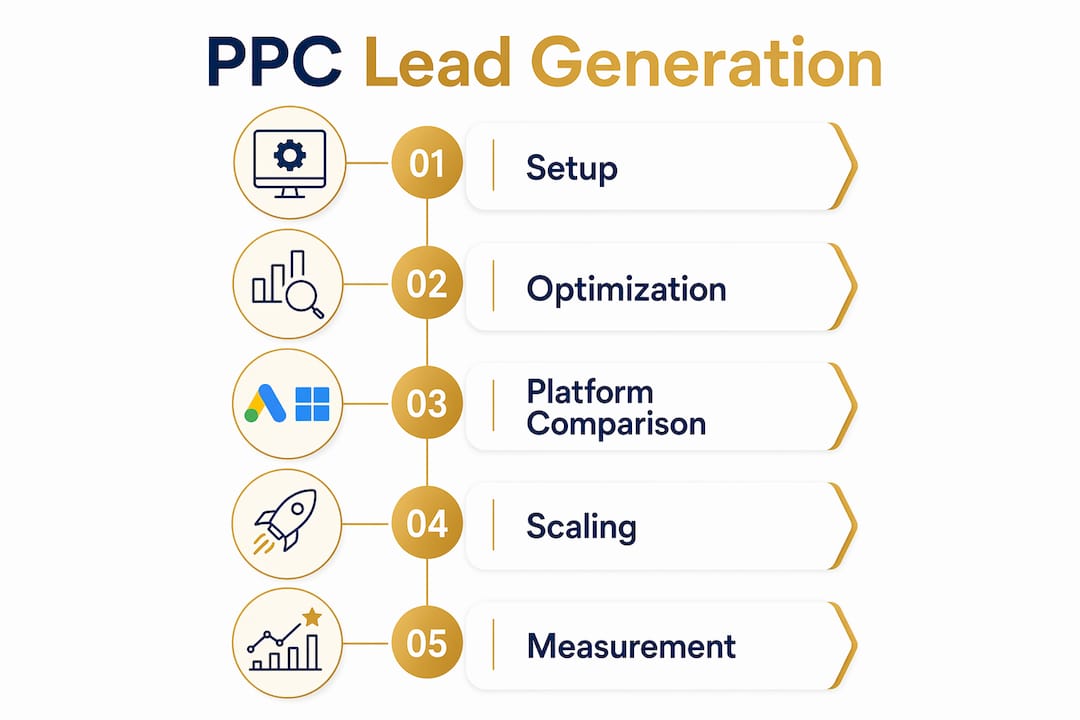
Comparing PPC strategies across platforms and campaign types
Not all paid advertising strategies produce the same type of lead. The platform and campaign format you choose determines the quality, intent level, and cost of the leads you generate.
| Campaign type | Best for | Lead quality | Typical CPL |
|---|---|---|---|
| Google Search with Smart Bidding | High-intent, ready-to-buy prospects | Very high | Higher |
| Performance Max with Smart Bidding Exploration | Expanded reach across Google’s full inventory | High to medium | Medium |
| YouTube Demand Gen | Mid-funnel trust building and brand-aware leads | Medium | Lower |
| Meta Ads (Facebook/Instagram) | Niche audience targeting and retargeting | Medium | Lower to medium |
| LinkedIn Ads | B2B service businesses and professional services | High for B2B | Highest |
Google Search campaigns remain the gold standard for PPC lead gen because they capture users who are actively searching for your service. Smart Bidding on Search campaigns, combined with tightly themed ad groups and strong negative keyword lists, produces the highest intent leads available in paid advertising.
Performance Max campaigns extend your reach across Search, Display, YouTube, Gmail, and Maps from a single campaign. With Smart Bidding Exploration enabled, the AI actively tests new audience segments and placements. The trade-off is reduced transparency over where your ads appear, which makes clean conversion data even more critical.
YouTube Demand Gen campaigns work differently. They build familiarity and trust before a prospect searches, which means the leads they generate are often warmer by the time they reach your Search ads. For service businesses like med spas, law firms, or clinics, this mid-funnel approach can significantly lower the cost of acquiring a high-quality lead across the full funnel.
Social media paid advertising through Meta Ads allows precise demographic and interest-based targeting. It works particularly well for service businesses targeting niche audiences such as beauty clinic clients or local retail shoppers. The leads tend to be less immediately ready to buy than Search leads, which means your follow-up sequence needs to be stronger.
Measuring and scaling successful PPC lead generation campaigns
Scaling a paid search campaign without degrading lead quality is the challenge most business owners and marketing managers face after initial success. The answer lies in data hygiene, AI utilisation, and disciplined budget management.
Google’s inline diagnostics tools inside Google Ads surface data health warnings when your conversion tracking is incomplete or your first-party data signals are weak. Treat these warnings as urgent. The AI bidding algorithms are only as good as the data you feed them, and poor signal quality is the fastest way to waste budget on unqualified leads.
Demand-led budget pacing technology automatically adjusts campaign spend to align with fluctuating consumer demand within your monthly limits. This means your budget concentrates during peak interest periods without requiring manual intervention. For a salon running a seasonal promotion or a law firm during tax season, this feature alone can materially improve cost efficiency.
AI Max and Demand Gen features within Google Ads allow you to scale reach without manually expanding keyword lists or audience segments. The key constraint is maintaining clean, rich first-party data. Feed your CRM data back into Google regularly, update your customer match lists, and import offline conversion events at least weekly. The AI improves continuously when it receives fresh, accurate signals.
Monitor secondary signals as you scale. Watch metrics like lead-to-appointment rate, appointment-to-quote rate, and quote-to-close rate alongside your Google Ads dashboard. A rising CPL is not always a problem if your close rate is also rising. Conversely, a falling CPL with a deteriorating close rate signals that your campaign is drifting toward volume over quality. You can find complementary lead generation tools that integrate with Google Ads to strengthen your measurement stack.
Pro Tip: Import offline conversions at least once per week. Google’s AI needs a minimum of 30 to 50 conversions per month at the campaign level to optimise effectively. If your campaign is below that threshold, consolidate ad groups or broaden match types temporarily to build signal volume before tightening targeting.
Key takeaways
Effective PPC lead generation requires combining Google’s AI-driven tools with clean first-party data, quality-focused bidding, and fast operational follow-up to convert paid search leads into actual revenue.
| Point | Details |
|---|---|
| Prioritise lead quality over volume | Measure cost per signed deal, not just cost per form fill, to assess true campaign profitability. |
| Use Enhanced Conversions from day one | First-party data matching delivers an average 8% ROAS lift and improves Smart Bidding accuracy. |
| Import offline conversion data weekly | Connecting CRM data to Google Ads produces a 26% average increase in incremental ROAS. |
| Match platform to funnel stage | Use Google Search for high-intent leads, YouTube Demand Gen for mid-funnel trust, and Meta Ads for niche targeting. |
| Fix intake before scaling spend | Missed calls and slow follow-up destroy lead quality gains made by even the best-configured campaigns. |
What I have learned running PPC lead generation for Australian businesses
The most common mistake I see from business owners starting paid search campaigns is treating Google Ads as a tap you turn on and leads flow out. It does not work that way, and the businesses that struggle most are the ones who optimise for the metric that is easiest to measure rather than the one that actually matters.
Raw form fills are easy to measure. Closed deals are harder to track but infinitely more useful as a bidding signal. Every client I have worked with who made the shift to value-based bidding and offline conversion imports saw their cost per acquisition drop within 60 to 90 days, not because they spent more, but because the AI finally had the right information to make better decisions.
The other thing that surprises people is how much operational performance affects PPC results. I have seen campaigns with excellent click-through rates and strong landing pages produce terrible ROI simply because the business was not answering the phone during peak hours. The ad does its job. The intake process fails. And the business blames the campaign.
AI is genuinely changing what is possible in lead generation campaigns right now. Smart Bidding Exploration, journey-aware bidding, and Demand Gen are not incremental improvements. They represent a fundamentally different way of finding customers. But the businesses that win with these tools are not the ones who hand everything to automation. They are the ones who pair automation with a clear business strategy, clean data, and a sales process that can actually close the leads the AI finds.
For Australian businesses specifically, the opportunity is real. Global PPC trends around AI-driven bidding and first-party data are directly applicable here, and the competitive intensity in most Australian markets is still lower than in the US or UK. That gap will not last.
, Business Warriors | Digital Marketing Agency
Take your PPC results further with Jarrod Harman
Running paid search campaigns that consistently generate quality leads requires more than a Google Ads account and a budget. It requires a strategy that connects your ads to your sales process, your CRM to your bidding algorithm, and your short-term spend to your long-term growth targets.
At Jarrodharman, we build data-driven PPC strategies tailored to service-based and retail businesses across Australia. Whether you are running a clinic, a law firm, an ecommerce store, or a multi-location franchise, the approach is the same: clean data, quality signals, and a system that optimises for revenue, not just clicks. Explore Jarrod Harman’s digital marketing expertise to see how a structured, results-focused approach can transform your paid advertising outcomes.
FAQ
What is PPC lead generation?
PPC lead generation is the practice of using pay-per-click advertising on platforms like Google Ads or Meta Ads to attract prospects and convert them into qualified leads. It differs from general PPC advertising because the primary goal is capturing contact information or booking intent, not just driving traffic.
How does Smart Bidding improve lead quality?
Smart Bidding uses machine learning to optimise bids based on signals like device, location, time of day, and user behaviour. Smart Bidding Exploration specifically increases unique converting users by 27% by finding new customer segments beyond your existing audience.
Why should I import offline conversions into Google Ads?
Offline conversion imports connect your CRM data to Google Ads, allowing the bidding algorithm to optimise for leads that actually become paying clients. Advertisers who complete this integration see a 26% increase in incremental ROAS on average.
What is the difference between cost per lead and cost per acquisition?
Cost per lead measures the expense of capturing a prospect’s contact details. Cost per acquisition measures the expense of converting that prospect into a paying client. Optimising for cost per acquisition, or cost per signed deal, produces far better ROI than chasing low-cost form fills.
How many conversions do I need for Smart Bidding to work effectively?
Google’s AI bidding requires a minimum of 30 to 50 conversions per month at the campaign level to optimise reliably. Below that threshold, consolidate campaigns, broaden match types temporarily, or include micro-conversions such as phone calls and quote requests to build sufficient signal volume.