7 June 2026
Benefits of paid social media advertising in 2026
Discover the benefits of paid social media advertising in 2026. Learn how precision targeting and real-time insights can boost your brand's visibility!
TL;DR:
- Paid social advertising enables precise audience targeting, real-time campaign control, and measurable results that organic posting cannot replicate.
- Businesses that treat paid social as an experiment pipeline optimize effectively and scale confidently through structured testing and segmentation.
Paid social media advertising is defined as the practice of paying platforms like Meta, TikTok, LinkedIn, YouTube, and X to distribute targeted ads to audiences defined by demographic, interest, and behavioural data. The core benefits of paid social media advertising are precision targeting, real-time measurability, and scalable budget control, three advantages that organic posting simply cannot replicate. Businesses that treat paid social as a structured experiment pipeline, rather than a broadcast channel, consistently outperform those that simply increase spend. According to Brandwatch, platforms let you define and bid for audiences rather than waiting for an algorithm to decide who sees your content. For any business owner or marketing manager serious about brand visibility and sales growth, understanding how paid social works mechanically is the starting point for using it well.
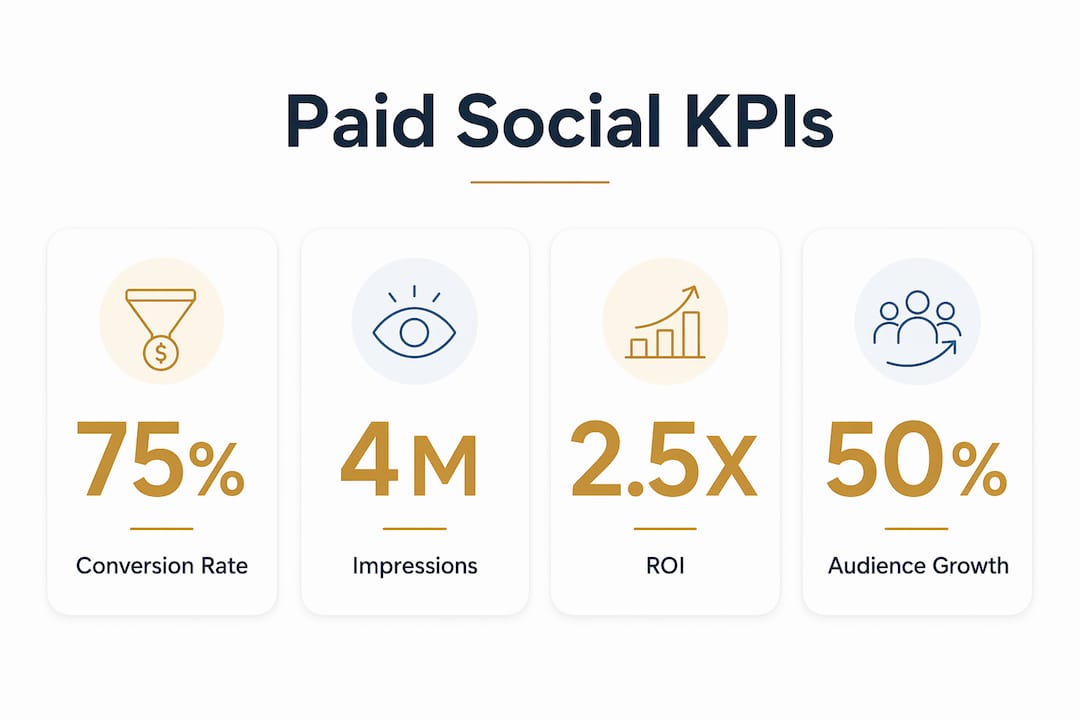
What are the benefits of paid social media advertising for targeting?
The single greatest advantage of paid social over organic posting is audience precision. Platforms like Meta and LinkedIn hold billions of data points on user behaviour, purchase intent, job title, location, and content preferences. You use that data to build an audience that matches your ideal customer, then pay to place your ad directly in front of them. Organic content reaches your existing followers and whoever the algorithm decides to reward. Paid placement removes that uncertainty entirely.

The bidding system on platforms like Meta Ads Manager rewards relevance and engagement, not just the highest budget. An ad with strong creative and a well-matched audience will outperform a poorly targeted ad with three times the spend. This means a service business in Perth with a $100 daily budget can compete effectively against a national brand if the targeting and creative are tighter.
Real-time campaign control is another practical advantage that marketers underestimate. You can pause an underperforming ad set within hours, shift budget to a winning creative, or narrow an audience mid-flight based on live data. This level of control is unavailable in traditional advertising channels like print, radio, or television.
- Target by postcode, age, gender, income bracket, job title, interests, and past purchase behaviour
- Exclude audiences who have already converted to avoid wasting spend
- Build lookalike audiences from your best existing customers using first-party data
- Layer interest and behavioural signals to reach niche segments with high purchase intent
Pro Tip: Build a custom audience from your email list or website visitors before launching cold prospecting campaigns. Warm audiences consistently convert at lower cost per acquisition than cold traffic, and the data from warm campaigns informs smarter cold targeting.
What measurable results do paid social platforms provide?
Paid social advertising provides real-time performance tracking across every stage of the customer journey, from first impression to completed purchase. You can measure impressions, clicks, landing page visits, form completions, purchases, and assisted conversions inside a single dashboard. This means you can connect every dollar of ad spend to a specific outcome, which is something most traditional marketing channels cannot offer.
Return on ad spend (ROAS) is the primary metric most marketing managers track. ROAS tells you how much revenue you generated for every dollar spent on ads. A ROAS of 3x means $3 in revenue for every $1 spent. However, platform-reported ROAS can overstate true performance because attribution models often credit the ad for conversions that would have happened anyway.
This is where incrementality testing becomes the gold standard. Incrementality testing measures the true causal impact of your ads by comparing conversion rates between an exposed test group and a control holdout group that never saw the ad. The difference between the two groups represents the genuine lift your campaign created. Without this, you risk scaling spend on ads that are claiming credit for organic conversions.
Platform attribution data can mislead budgeting decisions. Measuring incremental lift with test and holdout groups provides more reliable guidance for where to allocate your next dollar.
| Metric | What it tells you |
|---|---|
| Impressions | How many times your ad was displayed to your defined audience |
| Click-through rate (CTR) | How compelling your creative and copy are at generating interest |
| Cost per lead (CPL) | How efficiently your campaign converts interest into a contact or enquiry |
| ROAS | Revenue generated per dollar of ad spend, based on platform attribution |
| Incremental lift | The true additional conversions caused by your ads, measured via holdout testing |
Pro Tip: Run a holdout test on your best-performing campaign before scaling budget. Allocate 10% of your audience to a control group that sees no ads, then compare conversion rates after two weeks. The result will tell you whether your ROAS is real or inflated by attribution overlap.
Businesses starting out should note that modest monthly budgets of $3,000 to $5,000 are generally the minimum needed to generate enough conversion data for meaningful optimisation. Below this threshold, noisy results and algorithm instability make it difficult to draw reliable conclusions.
How does paid social support scalable testing and budget optimisation?
Paid social advertising is best treated as an experiment pipeline. You start with multiple creative variants and audience segments running simultaneously, identify what works, pause what does not, and scale the winners with defined budget increments. This process is repeatable and systematic, which is what separates businesses that grow their social media advertising ROI from those that plateau.
The practical steps for scaling a paid social campaign without losing performance are:
- Launch three to five creative variants per ad set to test messaging, format, and visual approach simultaneously
- Run each variant for a minimum of seven days before drawing conclusions, allowing the algorithm to exit the learning phase
- Pause any variant with a cost per result more than 30% above your target benchmark
- Scale winning ad sets by no more than 20 to 30% of daily budget at a time to avoid triggering an algorithmic reset
- Refresh creative every four to six weeks to prevent ad fatigue, which causes click-through rates to drop and costs to rise
Campaign architecture matters as much as creative quality. Separating campaigns by funnel stage, cold prospecting, warm retargeting, and retention, prevents budget from being misallocated across audiences with very different conversion probabilities. Mixing cold and warm audiences in a single ad set starves one segment and distorts your data.
Competitive intelligence is an underused tool for creative testing. Reviewing what competitors are running in Meta’s Ad Library, TikTok’s Creative Centre, and similar tools reveals which formats and messages are gaining traction in your market. This research informs creative briefs that are grounded in real market signals rather than internal assumptions.
Pro Tip: Use Meta’s Ad Library to search your top three competitors by name and filter by active ads. Look for ads that have been running for more than 30 days. Longevity is a strong signal that the creative is performing, and it gives you a tested hypothesis to build your own variant from.
What full-funnel marketing capabilities does paid social enable?
Paid social advertising is one of the few channels that supports every stage of the marketing funnel within a single platform ecosystem. A business can run brand awareness video ads to cold audiences on Instagram Reels, serve carousel ads to users who watched 50% of that video, and then retarget website visitors with a direct offer on Facebook. All three stages happen inside Meta’s ad platform, with shared data and unified reporting.
This full-funnel capability is a core paid social media benefit that Google Ads cannot replicate in the same way. Search ads capture demand that already exists. Paid social creates demand by interrupting users with relevant, well-timed content before they know they need your product or service.
| Funnel stage | Ad format | Primary goal |
|---|---|---|
| Awareness | Video, Reels, Stories | Reach new audiences and build brand recognition |
| Consideration | Carousel, lead forms, polls | Drive engagement and capture interest or contact details |
| Conversion | Retargeting, dynamic product ads | Close sales and recover abandoned intent |
| Retention | Custom audience ads, loyalty offers | Increase repeat purchases and lifetime customer value |
Full-funnel paid social campaigns also integrate naturally with organic social strategies. Organic content builds community and brand familiarity over time. Paid campaigns amplify the best-performing organic content to new audiences, extending its reach beyond your existing followers. The two approaches reinforce each other rather than compete.
How does paid social compare to organic and other digital channels?
Organic social and paid social serve different purposes, and treating them as interchangeable is a common mistake. Organic content builds brand familiarity and community engagement over time, while paid social expands reach and drives direct actions like clicks, enquiries, and purchases. Combining both produces stronger results than either approach alone.
The key distinctions between paid social, organic social, and Google Ads are:
- Organic social: Reaches existing followers and relies on algorithmic distribution. Builds trust and community but offers no targeting control and limited reach growth.
- Paid social: Reaches defined audiences regardless of follower count. Drives measurable actions with full budget control and real-time optimisation.
- Google Ads: Captures users who are actively searching for a solution. Average ROAS for search sits around 4.5x compared to 2 to 3x for social prospecting, because search intent is closer to purchase.
The practical implication is that paid social and Google Ads are not competitors. They address different stages of the buyer journey. Paid social interrupts and educates a cold audience. Google Ads converts the demand that paid social helped create. Running both together, as part of an integrated strategy, is consistently more effective than relying on a single channel.
For service businesses in particular, the ability to market on social media with precise local targeting makes paid social one of the highest-return channels available. A med spa, law firm, or salon can target women aged 35 to 55 within a 10-kilometre radius who have shown interest in relevant services, at a fraction of the cost of a local print or radio campaign.
Key takeaways
Paid social advertising delivers measurable, scalable results when campaigns are built around precise targeting, structured funnel architecture, and measurement that goes beyond platform-reported attribution.
| Point | Details |
|---|---|
| Precision targeting | Use demographic, interest, and behavioural data to reach your exact customer profile and reduce wasted spend. |
| Real-time measurement | Track impressions through to purchases live, and use incrementality testing to verify true campaign impact. |
| Scalable budget control | Scale winning ad sets in 20 to 30% increments and separate funnel stages to maintain algorithm stability. |
| Full-funnel capability | Run awareness, consideration, and conversion campaigns within a single platform ecosystem using matched ad formats. |
| Paid vs organic vs search | Paid social creates demand, organic builds community, and Google Ads captures intent. All three work best together. |
Why most businesses leave paid social money on the table
After working with service businesses across Australia at Business Warriors, the pattern I see most often is not a budget problem. It is a measurement and architecture problem. Business owners increase spend when results plateau, when the real fix is separating funnel stages, refreshing creative, or running a holdout test to find out what the platform is actually delivering.
The businesses that extract the most from paid social treat it like a structured testing system, not a tap you turn up when you need more leads. They define a creative cadence, review competitive intelligence before briefing new ads, and measure incrementally rather than trusting platform attribution blindly. They also integrate paid social with SEO, Google Ads, and email marketing so that each channel reinforces the others rather than operating in isolation.
AI tools are changing how quickly you can generate and test creative hypotheses. Platforms like Meta are building AI-driven ad optimisation directly into their interfaces, and third-party tools are making competitive creative research faster than ever. The businesses that learn to use these tools systematically will compound their advantage over those still running the same ad creative for six months and wondering why results have dropped.
The Marketing Vortex method we use at Business Warriors is built on exactly this principle: integrate channels, test systematically, and measure what actually moves the needle for your business.
, Business Warriors | Digital Marketing Agency
Ready to put these paid social advantages to work?
Business Warriors helps service businesses, e-commerce brands, and enterprises across Australia build paid social campaigns that are structured, measurable, and designed to scale. Our Marketing Vortex method combines Meta advertising, Google Ads, SEO, email marketing, and web development into a single integrated system, so every channel you invest in amplifies the others.
If you are a business owner or marketing manager ready to move beyond boosting posts and build a paid social strategy that connects spend to real outcomes, Jarrodharman has the frameworks, case studies, and hands-on expertise to get you there. Reach out to Business Warriors to discuss a paid social strategy built around your specific growth targets.
FAQ
What is paid social media advertising?
Paid social media advertising is the practice of paying platforms like Meta, TikTok, LinkedIn, and YouTube to distribute targeted ads to audiences defined by demographic, interest, and behavioural criteria. Unlike organic posting, paid ads reach users outside your existing follower base.
How much should I spend on paid social media ads?
A starting budget of $3,000 to $5,000 per month generates enough conversion data for meaningful optimisation and algorithm stability. Below this level, results are typically too noisy to draw reliable conclusions about what is working.
What is the difference between paid social and Google Ads?
Paid social interrupts users who are not actively searching to create demand, while Google Ads captures users who are already searching for a solution. Social prospecting typically delivers a ROAS of 2 to 3x compared to around 4.5x for search, reflecting the difference in purchase intent at each funnel stage.
What is incrementality testing in paid social?
Incrementality testing measures the true causal impact of your ads by comparing conversion rates between an exposed group and a control holdout group that never saw the ad. It is the most reliable method for verifying whether your platform-reported ROAS reflects genuine campaign impact.
How do I avoid ad fatigue in paid social campaigns?
Refresh ad creative every four to six weeks and maintain a systematic cadence of testing new variants. Using competitive intelligence tools like Meta’s Ad Library to identify proven formats in your market reduces the guesswork in briefing new creative.