1 June 2026
Vertical marketing strategy: the complete 2026 guide
Unlock the power of your sales with a tailored vertical marketing strategy in 2026. Boost conversions and ROI with targeted solutions!
TL;DR:
- A vertical marketing strategy focuses marketing efforts on specific industry niches, increasing lead quality and reducing costs. It aligns messaging and sales processes to industry-specific language, resulting in higher conversions and shorter sales cycles. Leveraging AI enhances targeting, content creation, and real-time data enrichment, driving measurable performance improvements.
A vertical marketing strategy is defined as the practice of concentrating your marketing and sales resources on specific industry segments or niches to deliver tailored, highly relevant messaging that increases conversions and marketing ROI. Rather than broadcasting generic campaigns to broad audiences, this targeted marketing approach speaks directly to the language, pain points, and buying behaviour of a defined customer segment. The result is measurably better lead quality, lower cost per acquisition, and faster sales cycles. When executed with modern tools like AI-driven segmentation, Google Ads vertical targeting, and CRM-integrated intent data, a vertical strategy transforms scattered outreach into a focused revenue engine.
How do vertical marketing strategies improve lead quality and cut costs?
The most compelling evidence for vertical marketing comes from the numbers. A 2026 manufacturing ABM case using geo-tagged plant segmentation and local-language ads achieved a 75% reduction in ad spend alongside a 2.5x increase in qualified leads. That result is not an anomaly. It reflects what happens when you stop paying to reach people who will never buy and start investing only in the accounts that match your ideal customer profile.
Generic broad-reach campaigns waste budget on irrelevant impressions. A vertical strategy eliminates that waste by defining precise audience parameters at the industry, sub-sector, and even location level. For manufacturers, that means targeting at the plant level rather than the corporate level. For service businesses in Australia, it means separating med spa owners in Perth from retail operators in Sydney and serving each group messaging that speaks to their specific operational pressures.
The efficiency gains extend beyond ad spend. Vertical-specific targeting at the plant or location level, combined with daily signal refreshes, keeps sales intelligence current and campaign relevance high. This is the difference between a static audience list and a dynamic operational system that updates as buyer behaviour changes.
Consider the contrast:
| Approach | Lead quality | Cost per lead | Sales cycle |
|---|---|---|---|
| Generic broad-reach campaign | Low fit, high volume | High | Long |
| Vertical-specific campaign | High fit, lower volume | Low | Short |
The trade-off is volume for quality. Vertical marketing produces fewer leads, but those leads convert at significantly higher rates because they were qualified by industry fit before they ever entered your pipeline.
Key advantages of a vertical marketing approach include:
- Reduced ad spend waste through precise audience segmentation
- Higher sales acceptance rates because leads match defined vertical criteria
- Shorter sales cycles due to industry-relevant messaging
- Stronger brand positioning within a defined niche
What makes vertical marketing messaging and internal alignment work?
Messaging is where most vertical strategies succeed or fail. Category engineering is the practice of defining buyer language and framing problems in the target vertical’s terms. It means teaching the market how to think about a problem before you present your solution. This creates lasting competitive advantage because you shape the conversation rather than respond to it.

A CCaaS provider that created vertical-specific narratives for Healthcare, Financial Services, Travel and Tourism, Retail, and the Public Sector demonstrated this principle in practice. Each vertical received its own campaign content, sales assets, and messaging framework. The result was accelerated demand generation because buyers recognised their own industry context in the communication.
Internal alignment is equally critical. A vertical-first go-to-market motion requires sales and marketing teams to share the same language, the same lead definitions, and the same onboarding frameworks. Without this, marketing generates vertical-relevant leads that sales teams mishandle because they are still operating with generic qualification criteria.
The steps to build this alignment are:
- Define vertical-qualified leads (VQLs) with explicit fit and intent criteria for each target vertical.
- Establish sales and marketing service-level agreements (SLAs) that specify handoff conditions and follow-up timelines by vertical.
- Create a shared glossary of vertical-specific terminology so both teams communicate consistently with prospects.
- Develop vertical-specific sales assets including case studies, objection-handling guides, and ROI calculators relevant to each industry.
- Run regular cross-team reviews to assess vertical pipeline health and refine messaging based on sales feedback.
Pro Tip: Build your vertical messaging around the operational language your buyers use internally, not the product language your team uses. A salon owner talks about “chair utilisation” and “rebooking rates,” not “service delivery efficiency.” Match their vocabulary and your conversion rates will reflect it.
How do you measure and optimise vertical marketing performance?
Measurement is where most businesses underinvest in their vertical strategy. Vertical marketing ROI is best tracked through targeted KPIs including pipeline generation, conversion rates, average deal size, and sales cycle length, all segmented by vertical. Without this granularity, you cannot distinguish which verticals are generating revenue and which are consuming budget without return.
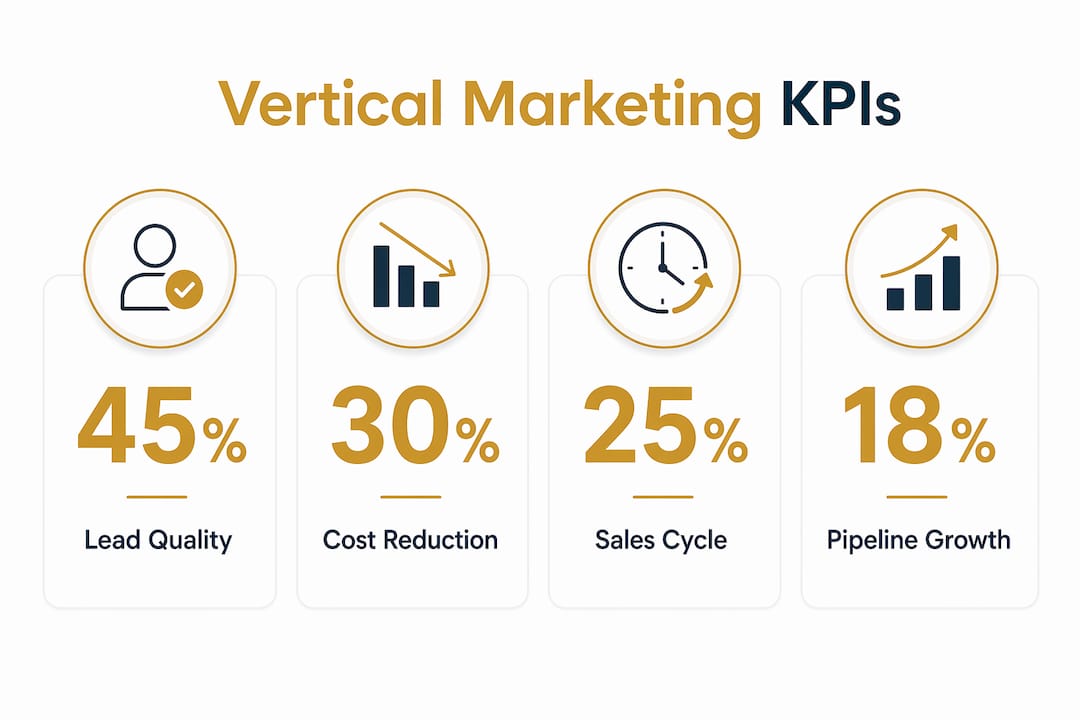
The KPIs that matter most in a vertical marketing context are:
| Metric | What it measures | Why it matters |
|---|---|---|
| Vertical-qualified lead (VQL) rate | Leads meeting vertical fit and intent criteria | Indicates targeting precision |
| Vertical conversion rate | VQLs converting to closed deals | Measures messaging and sales effectiveness |
| Average deal size by vertical | Revenue per closed deal within each segment | Guides investment allocation |
| Sales cycle length by vertical | Time from first contact to close | Reveals friction points in the funnel |
CRM platforms like Salesforce and HubSpot, combined with marketing automation tools like Marketo or ActiveCampaign, enable real-time vertical dashboards. The key is configuring these systems to tag every lead, opportunity, and closed deal with a vertical identifier from the first touchpoint. Without that data hygiene, your reporting will always be incomplete.
Modern MQL frameworks in 2026 integrate fit, engagement, intent, and stage signals with sales-marketing SLAs to improve pipeline contribution. This means moving beyond simple form fills and replacing them with multi-signal qualification that accounts for industry fit, content engagement depth, and third-party intent data from platforms like Bombora or G2.
Pro Tip: Track marketing-influenced pipeline separately from marketing-sourced pipeline. A vertical campaign that accelerates a deal already in progress is generating real value even if it did not originate the lead. Attribution models that ignore influence undercount your vertical marketing ROI by a significant margin.
What are the best vertical marketing strategy examples and applications?
The most instructive vertical marketing examples come from industries where the gap between generic and specific messaging is widest. In manufacturing, the ABM approach of targeting at the plant level rather than the corporate level produced results that corporate-level targeting had never achieved. Plant managers have different pain points than procurement directors, and campaigns that addressed operational uptime, safety compliance, and shift productivity outperformed campaigns focused on enterprise cost savings.
In the technology sector, CCaaS providers targeting the contact centre market found that vertical-specific content for healthcare buyers needed to address patient privacy, regulatory compliance, and clinical workflow integration. The same product, positioned through a healthcare lens, converted at a higher rate than a generic “improve your customer experience” message.
Best practices drawn from these and similar cases include:
- Build vertical-specific landing pages with industry terminology, relevant case studies, and sector-specific social proof.
- Use geographic segmentation within verticals. A beauty clinic in Brisbane faces different competitive pressures than one in Melbourne, and localised messaging reflects that.
- Value-based pricing aligns with industry context and willingness to pay for niche solutions. Vertical specialists command higher prices because buyers perceive lower risk in working with someone who understands their industry.
- Build community within your vertical through LinkedIn groups, industry events, and sector-specific content series. Community-driven vertical markets generate referrals that broad-reach campaigns cannot replicate.
- For B2B marketing in Australian service businesses, vertical segmentation between professional services, trade services, and health services produces meaningfully different conversion outcomes even when the core offer is identical.
How does AI enhance vertical marketing campaigns?
AI has shifted vertical marketing from a planning exercise to a real-time operational system. The most significant application is hyper-local keyword and ad generation. AI tools can generate hundreds of vertical-specific ad variations in multiple languages, test them simultaneously across Google Ads and Meta, and reallocate budget to top performers within hours rather than weeks.
For digital advertising in vertical contexts, AI-powered audience segmentation identifies micro-segments within a vertical that human analysts would miss. A Google Ads campaign targeting “med spa owners” is a starting point. AI refines that to “med spa owners in suburban areas with clinics operating for three or more years and monthly ad spend above a defined threshold,” producing a far more precise audience.
The role of large language models (LLMs) in vertical marketing is growing rapidly. LLMs like GPT-4 and Claude generate vertical-specific content at scale, from SEO-optimised blog posts to personalised email sequences tailored to a prospect’s industry role. For AI SEO and GEO (Generative Engine Optimisation), the goal is to get your brand mentioned in AI-generated responses when buyers in your target vertical ask questions. This requires publishing authoritative, vertical-specific content that LLMs recognise as credible source material.
Key AI applications in vertical marketing include:
- Real-time CRM data enrichment with intent signals from platforms like Bombora, refreshed daily to keep targeting current.
- AI-generated vertical content for SEO, including long-form guides, FAQ pages, and comparison articles that rank for industry-specific search queries.
- Paid social targeting on Meta using lookalike audiences built from your highest-converting vertical customers.
- Predictive lead scoring within Salesforce or HubSpot that weights vertical fit alongside engagement signals to prioritise sales outreach.
- Scaling digital marketing through AI-assisted campaign management reduces the manual workload of running multiple vertical campaigns simultaneously.
Key takeaways
A vertical marketing strategy delivers superior results because it replaces generic outreach with industry-specific messaging, precise segmentation, and aligned sales processes that convert at higher rates with lower spend.
| Point | Details |
|---|---|
| Define vertical-qualified leads | Replace generic MQL criteria with fit, intent, and industry-stage signals to improve sales acceptance. |
| Align sales and marketing language | Shared vertical terminology and SLAs prevent qualified leads from being mishandled at handoff. |
| Measure by vertical KPIs | Track pipeline, conversion rate, deal size, and cycle length separately for each vertical. |
| Use AI for real-time targeting | Daily CRM enrichment and AI-generated ad variations keep vertical campaigns current and competitive. |
| Engineer your category | Frame problems in the buyer’s language before presenting your solution to build lasting market authority. |
Why most vertical strategies stall before they deliver results
The businesses I see struggle most with vertical marketing are not failing on strategy. They are failing on execution discipline. They define their verticals, build the messaging, and then revert to generic campaigns the moment a quarter gets tight. The vertical strategy becomes a slide deck rather than an operating system.
The insight that changed how I think about this came from working with service businesses across Australia. The ones that won in their vertical were not necessarily the ones with the best product. They were the ones that published vertical-specific content consistently, trained their sales teams on vertical language, and measured pipeline by vertical every single week. Consistency compounded into market recognition. Buyers started associating those brands with their industry before a sales conversation ever happened.
AI has made this more achievable than it has ever been. You can now generate vertical-specific SEO content, run AI-optimised Google Ads campaigns, and maintain personalised email sequences across multiple verticals without a team of twenty. The constraint is no longer resources. It is the willingness to commit to a vertical long enough for the compounding to show up in your pipeline data.
The businesses that will dominate their verticals in the next three years are the ones building their brand into the answers that LLMs give when buyers ask industry-specific questions. That is the new frontier of vertical marketing, and it rewards the same discipline that has always separated vertical specialists from generalists.
, Business Warriors | Digital Marketing Agency
Ready to build your vertical marketing strategy?
If you are a business owner or marketing professional who wants to move from broad-reach campaigns to a focused, vertical-specific growth system, Jarrod Harman and the Business Warriors team have the frameworks to get you there. From AI-driven SEO and Google Ads to Meta advertising and full-funnel content strategies, every service is built around measurable outcomes in your specific market.

Explore how tailored digital marketing solutions can help you define your vertical, align your team, and build a pipeline that compounds over time. Business Warriors works with service businesses, clinics, e-commerce brands, and enterprises across Australia and beyond, delivering the kind of vertical-specific marketing that turns niche expertise into market leadership.
FAQ
What is a vertical marketing strategy?
A vertical marketing strategy is a targeted approach that concentrates marketing efforts on specific industry segments or niches, delivering tailored messaging that matches the language, needs, and buying behaviour of a defined customer group. It produces higher lead quality and lower cost per acquisition than generic broad-reach campaigns.
How does vertical marketing differ from horizontal marketing?
Horizontal marketing targets broad audiences across multiple industries with a single message, while vertical marketing tailors campaigns to the specific context of one industry at a time. Vertical strategies produce higher conversion rates because messaging aligns with industry-specific pain points rather than generic value propositions.
What are vertical-qualified leads (VQLs)?
Vertical-qualified leads are prospects that meet defined criteria for industry fit, engagement level, and purchase intent within a specific vertical. VQL frameworks replace generic MQL definitions to improve sales acceptance rates and reduce wasted outreach on out-of-vertical prospects.
How does AI support vertical marketing campaigns?
AI enables real-time audience segmentation, daily CRM data enrichment with intent signals, and automated generation of vertical-specific ad variations across Google Ads and Meta. Large language models also support AI SEO and GEO strategies by generating authoritative vertical content that earns brand mentions in AI-generated search responses.
What KPIs should I track for vertical marketing ROI?
The most useful KPIs are vertical-qualified lead rate, conversion rate by vertical, average deal size, and sales cycle length, all segmented by industry. Granular vertical dashboards within CRM platforms like Salesforce or HubSpot enable data-driven investment decisions across each target segment.