


TL;DR:
- Remarketing involves re-engaging warm contacts who have already interacted with your business but haven’t converted, using personalized channels like email or SMS.
- It differs from retargeting, which relies on paid ads and anonymous browsing data, with remarketing focusing on known audiences to build relationships.
If you’ve ever heard the terms “remarketing” and “retargeting” used interchangeably and wondered whether they actually mean the same thing, you’re not alone. This mix-up is one of the most common sources of confusion among service-based business owners, and it’s costing them real results. Getting clear on what remarketing actually means, how it works, and how it differs from retargeting can be the difference between a campaign that quietly recovers lost leads and one that burns your budget on the wrong audience. This article cuts through the noise and gives you a practical, no-fluff guide to using remarketing to grow your business.
Table of Contents
- What does remarketing actually mean?
- Remarketing vs retargeting: what’s the difference?
- How dynamic remarketing personalises results
- Simple steps to add remarketing to your strategy
- Why most service businesses miss the real value of remarketing
- Take the next step: grow your business with smarter marketing
- Frequently asked questions
Key Takeaways
| Point | Details |
|---|---|
| Remarketing re-engages warm leads | Remarketing targets those who already know your business, making it easier to build trust and drive action. |
| Know the difference | Understanding the line between remarketing and retargeting ensures you choose the most effective strategy. |
| Dynamic remarketing drives results | Personalised offers based on past behaviour increase conversions for both new and returning clients. |
| Start with owned data | Your email and CRM lists are a powerful foundation for successful remarketing campaigns. |
What does remarketing actually mean?
Before we get into practical steps and comparisons, let’s sort out what “remarketing” really means, because the word gets thrown around a lot without much precision.
At its core, remarketing means re-engaging people who have already interacted with your business, for example, visited your website or app, emailed you, or are sitting in your CRM or email list, but haven’t completed the desired next step yet. That next step might be booking an appointment, purchasing a package, or simply responding to a follow-up message. The key word here is already. These are warm contacts. They know who you are.
For service-based businesses, this distinction matters enormously. Think about a med spa owner whose website gets 800 visitors a month but only 40 bookings. The other 760 people didn’t just disappear. They browsed your services, maybe read your testimonials, and then got distracted. Remarketing is your system for following up with that group in a way that feels relevant and timely, not pushy or generic.
“Remarketing generally means re-engaging people who have already interacted with your business but haven’t completed the desired next step yet.” This is the foundation of every effective re-engagement campaign.
Common remarketing actions include:
- Sending a personalised email to a past client who hasn’t rebooked in 60 days
- Offering a special package to someone who filled in a contact form but never confirmed
- Sending an SMS to existing clients about a new service they haven’t tried
- Following up with leads who attended a webinar or downloaded a freebie
Understanding this foundation makes it far easier to build launching marketing campaigns that are targeted, cost-effective, and genuinely relevant to the people you’re reaching out to.
Remarketing vs retargeting: what’s the difference?
Now that you know what remarketing is, let’s clear up a common misunderstanding: how it differs from retargeting. These two terms overlap in everyday conversation, but they describe meaningfully different approaches.
Remarketing and retargeting overlap in industry usage, but a useful working distinction is this: remarketing leans on owned channels and first-party data, like your email list or CRM, while retargeting leans on paid ad platforms and pixel-based audience building, such as the Facebook Pixel or Google Ads tracking cookies.
Here’s a simple way to think about it. Remarketing is the phone call you make to a client you already know. Retargeting is the billboard you put up in their neighbourhood after they visited your shop.
| Feature | Remarketing | Retargeting |
|---|---|---|
| Data source | CRM, email list, phone numbers | Pixel data, cookies, ad platform audiences |
| Primary channel | Email, SMS, direct outreach | Google Ads, Meta Ads, display ads |
| Cost model | Usually lower cost per contact | Paid per impression or click |
| Audience relationship | Warm, known contacts | Visitors who are often anonymous |
| Personalisation | High, uses known data | Moderate, based on browsing behaviour |
| Best use | Re-engaging existing contacts | Re-engaging anonymous site visitors |
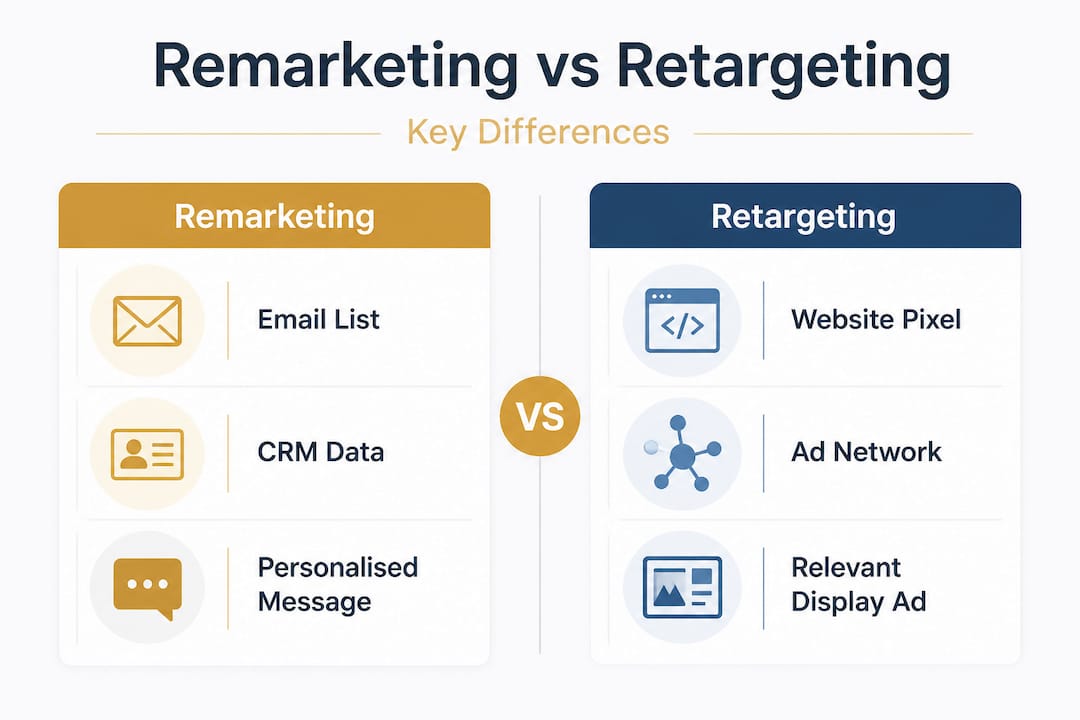
Both approaches are powerful, and the smartest campaigns use them together. However, knowing which tool to reach for first depends on what data you already have and what outcome you’re chasing. Understanding this distinction also makes marketing attribution strategies far easier to manage, because you can clearly see which channel is doing the re-engagement work and measure accordingly.
Pro Tip: If you’re just starting out, remarketing through your email list is often the fastest and most affordable place to begin. You already own that data, and the cost of sending a well-crafted email campaign is minimal compared to running paid retargeting ads.
How dynamic remarketing personalises results
Understanding the types of remarketing opens up new ways to re-engage your audience, especially through dynamic personalisation, which takes the concept to a more sophisticated level.
Dynamic remarketing shows ads containing the specific products or services a visitor viewed, using messages tailored to the audience based on their previous browsing behaviour. In plain terms, it means your ads automatically update to show each person something relevant to what they already looked at on your website.
For a beauty clinic or wellness centre, this is a game changer. Imagine a visitor who spent several minutes on your “hydrofacial treatment” page but didn’t book. With dynamic remarketing, that exact person can see an ad for the hydrofacial the next time they browse the web or scroll through their social feed. It’s not a generic “book now” message. It’s a tailored reminder of the specific service they were already interested in.
Here’s a practical breakdown of how dynamic remarketing scenarios play out for service businesses:
| Business type | Visitor behaviour | Dynamic ad shown |
|---|---|---|
| Med spa | Browsed laser hair removal page | Ad for laser hair removal with current offer |
| Salon | Viewed colour treatment packages | Tailored ad for hair colour consult or booking |
| Wellness clinic | Checked massage therapy page | Ad highlighting first-session discounts |
| Law firm | Read about family law services | Remarketing ad for free initial consultation |
| Fitness studio | Viewed group class timetable | Ad promoting class pack deals or trial offers |
To implement dynamic remarketing effectively, follow these steps:
- Set up a product or service feed linked to your website, listing every service you offer with descriptions, images, and pricing.
- Install tracking tags on your website so the platform can record which services each visitor viewed.
- Create a dynamic ad template in Google Ads or Meta Ads that automatically pulls in the relevant service details for each viewer.
- Define your audience segments, for example, visitors who spent more than 60 seconds on a specific service page.
- Set a frequency cap so your ads don’t follow people around in a way that feels intrusive or annoying.
This level of personalisation is what separates average campaigns from those that genuinely recover lost leads and drive digital advertising tips that move the needle. When your ads speak directly to what someone was already considering, the relevance is immediately higher, and that translates into better click-through rates and more bookings.
Simple steps to add remarketing to your strategy
With the groundwork laid, here’s how to make remarketing a regular part of your marketing routine rather than a one-off experiment.
Remarketing is a digital strategy to re-engage past visitors and contacts, but the execution is where most business owners either get traction or get stuck. The steps below are designed to be realistic and actionable for service-based business owners who are managing their marketing alongside running a busy practice.
-
Identify your remarketing audience. Start with what you have. Pull your email list, past client database, or CRM contacts. Segment them based on behaviour, for example, clients who haven’t rebooked in 90 days, leads who enquired but didn’t convert, or people who attended a free event.
-
Develop messaging that addresses specific interests. Generic messages get ignored. If someone enquired about teeth whitening three months ago but never booked, your follow-up message should reference teeth whitening specifically. Speak to the reason they came to you in the first place.
-
Choose the right channels for your audience. Email works well for existing clients and warm leads. SMS tends to get higher open rates and suits appointment reminders or limited-time offers. Dynamic ads work well for website visitors who are still in research mode. Knowing how to generate leads in digital marketing means matching the message to the medium.
-
Set up automated follow-up sequences. A single follow-up email rarely converts. Plan a sequence of three to five touchpoints over two to three weeks, each offering a slightly different angle or value add. One email might share a client success story. Another might offer a limited-time incentive. A third might simply ask if they have any questions.
-
Monitor results and adjust. Track open rates, click-through rates, and conversion rates for each remarketing sequence. If one segment isn’t responding, adjust the message or the channel before writing it off. You can also learn how to build marketing communities that keep warm leads engaged between direct outreach efforts.
-
Focus on client retention as part of your strategy. Remarketing isn’t only about winning back lost leads. It’s also about deepening the relationship with existing clients so they keep coming back. Systems that improve client retention are some of the highest-ROI activities in any service business.
Pro Tip: Start with one audience segment only, for example, clients who haven’t booked in 60 days. Run a focused three-email sequence, measure the result, and then expand. Starting small gives you clean data and stops you from feeling overwhelmed.
Why most service businesses miss the real value of remarketing
Here’s an uncomfortable truth most marketing advice glosses over: the majority of service business owners who try remarketing treat it like a salvage operation. They only activate re-engagement campaigns when bookings drop or revenue dips. That reactive mindset is exactly why their results stay average.

Remarketing, at its core, means re-engagement marketing, but the businesses that get the most out of it understand that re-engagement is really about relationship building, not just transaction recovery. Every follow-up email, every personalised ad, every check-in message is a touchpoint that shapes how your audience feels about your brand. When it’s done well, it doesn’t feel like marketing at all. It feels like good service.
The real shift happens when you stop seeing warm leads as “people who didn’t convert” and start seeing them as “people who are still deciding.” That reframe changes everything about how you write your messages, how often you follow up, and what you offer. A lead who browsed your services six weeks ago isn’t cold. They’re still in the consideration phase. A thoughtful, value-focused follow-up at the right moment can be all it takes to move them forward.
We’ve seen this play out consistently with service-based clients. The ones who build automated remarketing sequences with genuine value at each touchpoint, for example, a useful tip, a client story, an honest answer to a common question, consistently outperform those who just send “we miss you” discount emails. Combining authentic value with smart automation is the formula. And integrating this into a broader digital sales strategies framework means every part of your funnel is working together rather than in isolation.
Treat every repeat interaction as a customer service moment. When your remarketing feels helpful rather than desperate, people respond. That’s not a theory. It’s what the data consistently shows across every industry we work in.
Take the next step: grow your business with smarter marketing
If this article has clarified the remarketing meaning for you and sparked some ideas about how to put it into practice, the next move is to make sure you have the right systems in place to actually execute.
At Business Warriors, we’ve built our entire approach around integrated, omnichannel strategies that bring remarketing, SEO, paid ads, and email together into one seamless system. Jarrod Harman’s marketing vortex method is specifically designed for service-based business owners who want consistent, predictable leads rather than the feast-or-famine cycle. If you’re ready to see how a structured remarketing strategy fits into a complete growth system, explore our online client acquisition tips or take a closer look at the person behind the method and meet Jarrod Harman to understand the experience driving these results.
Frequently asked questions
Is remarketing only for product-based businesses?
No, remarketing works for both service and product businesses. It helps reconnect with anyone who engaged but didn’t become a paying client, making it highly effective for salons, clinics, law firms, and other service providers.
Which is better for my business: remarketing or retargeting?
The best choice depends on your audience and goals. Remarketing suits owned channels and first-party data like your email list, while retargeting works well when you want to re-engage anonymous website visitors through paid advertising platforms.
How can I start a remarketing campaign on my own?
Begin by organising your client and contact data, writing a personalised message that speaks to their specific interest, and using email or ads to reconnect with those who showed interest but didn’t take the next step.
Does dynamic remarketing use my client’s browsing data?
Yes, dynamic remarketing uses browsing behaviour to show visitors tailored ads or offers based on the specific services they viewed on your website, making the follow-up feel highly relevant rather than generic.
Recommended
- How to Generate More Leads from Your Website Easily – Jarrod Harman
- Lead Generation Strategies – Boost Sales Online Fast – Jarrod Harman
- How to Generate Leads in Digital Marketing: Proven Strategies – Jarrod Harman
- How to optimise your website for 50% more leads – Jarrod Harman
- Ad targeting: boost ROI and reach the right audience – Palmador Blog